Sunday, February 9, 2020

Hermeneutic Unpacking the Metaphors of Salt and Light in Jesus’ Sermon on the Mount Kerygma

Some people still think that religion and science cannot get along. They tend to interpret religious texts, including the Bible, too literally.  As David Tracy (1978) has said, all major religions have certain root metaphors as a common place. In other words, metaphor is a common integral element for many religions, and Christianity is no exception to this. However, if your abilities to interpret a religious text limited to literal meaning, you are less likely to appreciate  what religion makes deeply meaningfully through its texts’ unique rhetorical devices, including metaphors. But, if you can see metaphor as an important element to give taste and flavor to a religion, then, your hermeneutical abilities enables you to transcend the letters of religious text and discover a truth in the spirit of the letters of the text.  In fact, this is how Hans-Georg Gadamer and Paul Ricoeur argue for hermeneutics.  Now with this in mind, let’s visit the Gospel text for the 5th Sunday in Ordinary Time on Cycle A: Matthew 5:13-16.

The text is pretty much with logos in Jesus’ kerygma from the early part of the Sermon on the Mount. And, these are the words of Jesus proclaimed, as in the text.

You are the salt of the earth.
But if salt loses its taste, with what can it be seasoned?
It is no longer good for anything
but to be thrown out and trampled underfoot.
You are the light of the world.
A city set on a mountain cannot be hidden.
Nor do they light a lamp and then put it under a bushel basket;
it is set on a lampstand,
where it gives light to all in the house.
Just so, your light must shine before others,
that they may see your good deeds
and glorify your heavenly Father.

In his kerygma, Jesus calls us to be the salt of the earth and the light of the world.  By being the salt of the earth, Jesus wants us not to lose its taste, while not being hidden as the light to illuminate the world.  Understanding what Jesus meant by being the illuminating light of the world is relatively easier than meaning behind being salt of the earth, not losing its taste. So, what did Jesus really mean by calling us to be the tasteful salt of the earth? Does it have something to do with the salt deposit in the earth or salt in the ocean water? Or, this is Jesus’ unique rhetorical technique in using a figurative metaphor?

Image result for salt and light bible image

A key to tackle such questions is it is helpful to pay attention to “loses its taste” and “no longer good” in v. 13. In the original Greek text, Matthew uses “μωρανθῇ”(moranthe) for “loses its taste” and “οὐδὲν ἰσχύει”(ouden ischyei) for “no longer good”.  Moranthe originally means losing functionality or becoming insipid, as well as stupid, while ouden means nothing and ischyei means potent, vigorous, strong. Thus, ouden ischyei suggests the state of no functionality. So, Jesus wants us to be the kind of salt that never loses its functionality, as he calls us to be the salt of the earth. Now, think of the functionalities of salt.


In the original Greek word for salt, ἅλας (halas), we can find a hint, as it has a nuance of preserving and flavoring. These have been certainly well-known functions of salt ever since the ancient time.  Before refrigeration, our ancestors used to preserve meats and fish in salt.  And, salt has been used as seasoning agent ever since the humans began using it. Therefore, being the salt, we work hard to preserve Jesus’ salvific teaching, the truth, in his Gospel. Ever since the time of the Old Testament, there have been heretical teachers (i.e. Jeremiah 23:16) and Jesus also warned against such ones (i.e. Matthew 7:15).  And, even today, the teaching in the sacred biblical texts and the doctrine of the Church have been attacked to false teachers and heretic theologians. Today, in this post-Vatican-II era, they take “aggiornamento” aspect of the Vatican II Council to their own “progressive” extremes into heretical theological views, as to ignore Paul’s warning in Romans 12:2. If we fail to honor and act on the truth in Romans 12:2, then, we sure would become moranthe (tasteless) salt with no ἰσχύω(ischuo), potency, power. And, becoming ouden ischyei (unable to function, lost potency), we cannot serve as the agent to preserve the truth and the Church, as it would also mean to confirm to the darkness of the world, against which Paul warns in Romans 12:2. Then, we would be just as foolish (moranthe) as a concealed lamp stand.


To be the kind of salt with the functionality of preserving, we serve the Lord as his agents to keep the Church from falling into the darkness of this world, infested with heretic teachings. As long as we are able to function with wisdom (1 Corinthians 12:8), knowledge (ibid.), and discernment (1 Corinthians 12:10) through the Holy Spirit, then, we remain as the salt with full ἰσχύς (ischus), potency, uncompromising to heretical teachings and secular wisdom that may corrupt our minds, such as relativism, under the guise of “aggiornamento”. After all, being the salt of the earth with full potency (not losing its flavor) means that we can preserve the purity of the Church so that she will be the worthy virgin to marry Christ at the eschaton (Revelation 19:1-9).

As to another functionality of halas (salt), seasoning, being the salt means that our presence shall help one another savor meaning of life in Christ. It can also means that we are not boring persons. So, when we speak, nobody shall fall asleep out of boredom. In this regard, a preacher whose teaching is gravitating and helpful in discerning meaning of life, in light of the truth in Jesus’ teaching, is a good example of the halas with ischus, salt with full taste, potency.

Now, I invite you to think of the functionality of salt from your grade school science lab class. Perhaps, you remember that salt water has better electrical conductivity than plain water. As you kept adding and resolving more salt into plain water, you noticed that the electrical conductivity of the water increasing.  You remember the light bulb grew brighter as more salt became resolved in the water. We learned that it was because positive sodium ions attract the negative electrons, making the electric current, which is constant flow of electrons, pass through the water easier. Scientifically, salt makes the electric conductivity of water easier, as electrolyte. Because of this, salt is indispensable for our body to maintain its normal physiological function for the sustenance of life (biological life). If no sodium ion in our body fluid, due to no salt, then, we may die from a cardiac abnormality. Physiologically, salt is an essential agent to our nervous system to regulate and punctuate the electrochemical functionality of the biological life of our body due to the salt’s potency of electrical conductivity as resolved in water.

Image result for salt water electrical conductivity mechanism image

Let’s see how this scientific fact about salt’s functionality as an agent of electrical conductivity in water can be applied in hermeneutics of the above Gospel text on Jesus’ teaching on being the salt.

Say, we consider electricity as a metaphor for the Holy Spirit, and the electric current (flow of electrons) as a metaphor for what Pope Francis fondly calls “the current of grace” for the Church’s charismatic renewal. And, say, water, in which salt is to be resolved, is a metaphor for the earth or this world, as 71% of the earth is actually composed of water. Now, with these juxtapositions, as the fully potent salt of the earth, we function as the agent of conductivity of “the current of grace” in the Holy Spirit through the earth. As electricity in electrons flows from higher voltage potential to lower voltage potential, the Holy Spirit is sent out from the Father in heaven in Jesus’ mighty name to us on earth (John 14:26), and the outpouring of the powerful Holy Spirit on Pentecost from heaven to the disciples on earth (Acts 2:1-13) is a good example.


Actually, the Holy Spirit does not necessarily need us to propagate the grace, because as in Trinity, the Holy Spirit is God. Therefore, almighty God does not need any agents to propagate whatever He wills to. However, out of His love, God calls us to function as His chosen agents of “the current of grace” in the medium of the Holy Spirit. Because God loves us so much to the point of making His only begotten Son to dwell among us so that we may have eternal life as he does (John 1:1, 14; 3:16), it is in His desire that we function as His agents to propagate the Holy Spirit, through which “the current of grace” flows.  

The world is composed of two agents in terms of the conductivity of “the current of grace” in the Holy Spirit. We, the salt of the earth, the agents for better conductivity, as the salt in the water makes the electrical conductivity in the water better. The other is obstacles for the conductivity of the Holy Spirit, trying to keep the world dark from being illuminated by the wisdom in the Holy Spirit. As our presence in the world increases, we can overcome the impeding forces from these obstacles, thus making the Holy Spirit conductivity in the world better, just the electrical conductivity in the water increases as more salt is put into the water. 

Sunday, January 26, 2020

Have You Encountered the Manifesting Christ and Begun Following Him?

Having gone through the Advent Season and Christmas Season, we are now well into the Ordinary Time! It is already on the 3rd Sunday in Ordinary Time. 

We finished the Advent Season at the sundown of Christmas Eve.

We completed the Christmas Season in celebrating the Baptism of the Lord.

On the 2nd Sunday in Ordinary Time, we were reminded by John the Baptist that Christ who was born to us and was baptized to launch his public ministry is indeed "Agnus Dei, qui tollis peccata mundi".

So now on the 3rd Sunday, this Agnus Dei, who is already in full manifestation has launched his public ministry and calling us to follow him! 

Have we encountered him? He is no longer in obscurity, as he was during the Christmas Season. So, how can we say we have not seen him? And, how can we afford not to follow him upon encountering him? 

Ahora, que dejarias por sequir a Jesucristo, el Senor? 

                                                                              *****

It is the 3rd Sunday in Ordinary Time (Cycle A). It means, by now, nobody should miss Christ’s presence among us! Not only he has been manifesting but he has begun his public ministry! In fact, the 3rd Sunday in Ordinary Time reflects how Christ has initiated his ministry of bringing the good tidings to us. This is what we have longed for when we started a liturgical year on the 1st Sunday of Advent. Not just the Nativity of the Lord.

Though the Advent Season is often regarded as the preparatory period for the Nativity of the Lord, actually, it is the preparation for what the entire Christmas Season is meant for. And it is not only the birth of the Lord but his growth to the point of the initiation of his public ministry. And, the Baptism of the Lord signals Christ’s readiness to begin his public ministry to proclaim that the Kingdom of God is at hand (Matthew 3:2, 4:17:Mark 1:15), building upon John the Baptist’s preaching (Matthew 3:2).

Throughout the Advent Season, we prepared ourselves for the coming of Christ in anamnesis, based on the Gospel accounts and Messianic prophesies in the Old Testament. On the First Sunday of Advent, we reflected on how we should prepare for the coming of Christ in retrospect, juxtaposing to the way we should prepare ourselves for the parousia (Christ’s second coming to consummate the God’s own prophesy against Satan in Genesis 3:15, as envisioned in Revelation 20:10). Then, on the 2nd Sunday of Advent, we reflected on how John the Baptist preached the Israelites to prepare the way of Christ’s coming, as the voice crying out in the wilderness, as Isaiah had prophesized (Isaiah 40:3).

During the Advent Season, some of us might have thought that John the Baptist was preaching to prepare for the Nativity of the Lord. But, he was really calling the Israelites to be ready to meet Christ in his public appearance. In fact, when Christ was born, nobody but the shepherd recognize his adventus (Luke 2:1-20).  Christ did not manifest to the public until he grew up and came to meet John the Baptist to be baptized by him. And, the Baptism of the Lord marks the beginning of his public manifestation to launch what he was called for by the Father. In the current Liturgical Calendar, as revised in 1969, the Sunday feast of the Baptism of the Lord signals the end of the Christmas Season, which follows the Advent Season.

To put the significance of the 3rd Sunday in Ordinary Time in the spectrum of Advent, Christmas, and Ordinary Time, what we have been preparing for ever since the Advent Season is to encounter Christ in his action of public ministry as he has just begun. And, this is what the 3rd Sunday in Ordinary Time Gospel readings (Matt 4:12-23(A); Mark 1:14-20(B); Luke 1:1-4; 4:14-21) invite us: To encounter Christ, who has been manifesting in public and among us already, ever since his Baptism, except for these 40 days and nights in the wilderness (Matthew 4:1-11//Mark 1:11-13// Luke 4:1-14)! And, through our encounter with the manifesting Christ in his action, we must respond!

For Cycle A and Cycle B, the Gospel readings on the 3rd Sunday in Ordinary Time (Matt 4:12-23(A); Mark 1:14-20(B); for Cycle C, the Gospel reading on the 5th Sunday in Ordinary Time (Luke 5:1-11)), remind us that the manifesting Christ is calling us to follow him, so that we will be trained to carry out his mission as his disciples and to be sent out to the ends of the earth as his apostles – to bring the Good News, taught by him.


All our Advent preparation has led us not only to the Nativity of Christ but to celebrate his Baptism in concluding the Christmas Season. Upon the Christmas Season, entering into the Ordinary Time, Christ has been in full manifestation and taking actions in his public ministry. So, now we have come to this moment of encountering the manifesting Christ in his action, who is calling each one of us to follow him.
So, will you follow Christ as he now calls you to do so?

Will you drop everything that represent your old life style to follow him for a new life that he will lead to, as these fishermen in Capernaum drop their fishing nets and followed him, about 2,000 years ago? 

To follow Christ also means to be one with him, as he is so with the Father, who has sent him, (John 14:20; 17:21, 23). So, we can afford to decline his invitation to follow him and to be one with him? Remember, whatever Christ the Son speaks obediently reflects what is in the Father’s heart for us (John 5:19; 8:28, 12:49; 14:10, 24, 31; 17:8).

Now is the time to follow Christ!

Jesucristo dijo, “Deja todo y sigue me!”

Tuesday, December 31, 2019

Maria Lactans – Honoring Mary as the Theotokos on the Octave Day of Christmastide

The octave day in the Christmastide is marked as the solemnity of Mary as the Theotokos, though it was formerly celebrated as the feast of the Circumcision of the Lord. It was because baby Jesus was circumcised and given his name, Jesus, on the 8th day from his birth (Luke 2:21) in accordance with the brit milah mizvah of Leviticus 12:3.

On the Christmas octave day, a focus has shifted from the circumcision of the Son to his mother, Mary so that we can reflect on how baby Jesus was on the 8th day from his birth with his mother, Mary.  Certainly, it is much better to reflect on Mary holding on 8-day-old baby Jesus in her breast than the circumcision of baby Jesus on his 8th day of life.

What did 8-day old baby Jesus really look like with his mother, Mary? Imagine, 8-day-old baby Jesus being held in Mary’s breast, perhaps sucking breast milk from her nipple.

An image of Mary and baby Jesus together, baby Jesus held in Mary’s breast, being nursed by her love. And, this motherly love for her newborn baby may be symbolized by her life-sustaining breast milk and the breast itself. 

Image result for maria lactans art


Baby Jesus on his 8th day of life incarnate is extremely vulnerable and cannot survive without Mary’s breast. Unless Mary offers her breast to him, baby Jesus would not survive, not to mention, to thrive. Though he is God himself, the Messiah King, he came to this world as such a baby so vulnerable totally on the mercy of her mother’s loving care. And, as the handmaid of God (Luke 1:38) to serve God as the Theotokos, Mary gives her breast to her son, the Son of God, so that he can grow healthy and strong.

An image of Mary breastfeeding baby Jesus, not only give a sense of peace but secureness, keeping from anxieties. And, later in his life, Jesus himself invites us to this kind of peace and secureness as he calls us to be one with him as he is one with the Father.

As we complete the Christmas Octave in honoring Blessed Virgin Mary as the Theotokos with an image of Maria Lactans,  we also reflect that the love of God inviting us to rest in through Christ (John 14:20) in nursing Mary’s love for her Son, sucking her breast and resting there peacefully.

Maria Lactans not only represents the secure attachment of baby Jesus to his mother, Mary, but also our secure attachment to God, for which God the Father sent His only begotten Son, to which Mary has become the Theotokos as the handmaid of God.  Additionally, Maria Lactans, can be a heartwarming symbol that God’s chesed  can be compared to nursing mother’s love for her baby, as reflected in Isaiah 66:10-13.


May the New Year bring abundant blessings and grace of God like the richness of breast milk from Mary's breast that has nourished baby Jesus! 


Monday, December 30, 2019

Christmas Octave Reflection of the Holy Family and Christian Families


Now we are in the Christmas Octave to continue reflecting what it means to have the Logos-Theos incarnated (John 1:1) to dwell among us (John 1:14). This God incarnate is, indeed, Emmanuel (Matthew 1:23; Isaiah 7:14, 8:8; cf. Matthew 28:20), which means “God with us”, named Jesus (Matthew 1:25), which means “יה (yah), Yahweh (יהוה), will save”.  The Father in heaven has sent him to us as our Messiah King out of his salvific love (John 3:16). Yes, the Nativity of the Lord, the very first theophany by the incarnation of the Logos-Theos, is indeed the very first sacramental manifestation of God’s חסד (chesed), steadfast covenant love, for us!

The Sunday following the Nativity feast of the Lord (Christmas Day), during the Christmas Octave, is the feast Sunday of the Holy Family, as instituted by Pope Leo XIII in 1893. This suggests that the Nativity of the Lord must be celebrated, appreciated, and understood, in the context of the Holy Family, not only during the Christmas Octave but throughout the entire Christmastide. And, the Holy Family, to which Christ was born, represents what Christian families are to be. 

So, what is the nature of the Holy Family that Christian families can model?

It is, indeed, the steadfast faith in God, leading to obedience to God’s will.

As Luke 1:38 describes, Mary demonstrated her faith in God through her obedience to God’s will for her to be the Theotokus, while she was betrothed to Joseph but not yet consummated her engagement into matrimony.  Finding out of Mary’s out-of-wedlock pregnancy, Joseph was planning to divorce her quietly as it is not legal to marry a woman pregnant with a child, who is not his, but loved her enough to protect her from legal consequence, which is a death penalty (Matthew 1:18-19). Then, Joseph learned from Angel Gabriel, who made the Annunciation of her virgin pregnancy to her, that Mary was made pregnant by the power of the Holy Spirit according to God’s will (Matthew 1:20-23). To this, Joseph responded with his obedience and welcomed Mary as his wife and the son in her womb as his step son (Matthew 1:24-25), because Joseph is just as obedient to God as his wife, Mary, is. The obedience that both Mary and Joseph have demonstrated reflects their uncompromising faith.
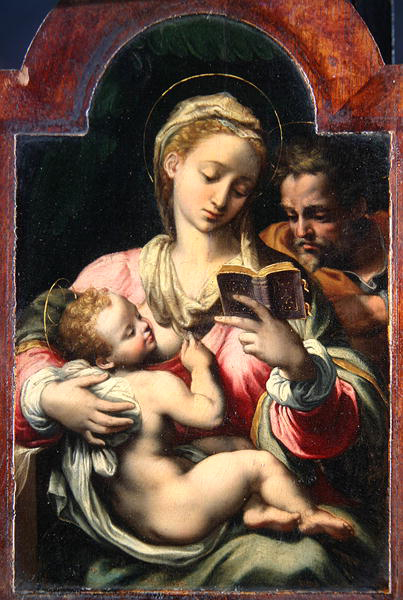
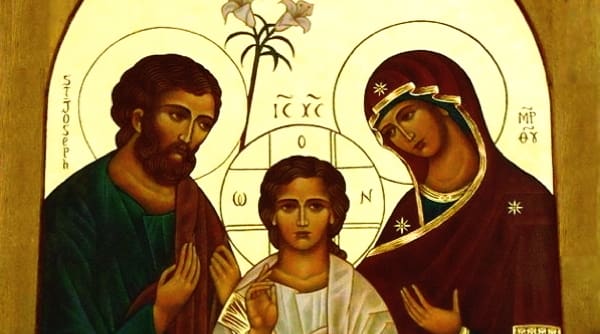
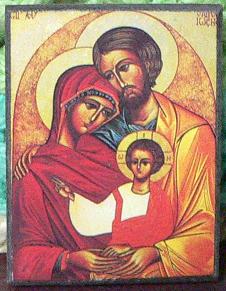
Image result for image of the holy family


Jesus was born to this faithful couple, Mary and Joseph, whose faith made them obedient to God. Therefore, it is evident that Jesus’ absolute faithfulness and obedience to the Father and His will (John 4:34, 5:30, 6:38, 8:26, 10:18, 12:49-50, 14:30-31, 15:10; Matthew 26:39//Mark 14:36//Luke 22:42; Luke 23:46; Philippians 2:8) was affected by the obedience of Mary and Joseph during his formative years in the Holy Family.

See, not only Mary and Joseph but Jesus are all faithful, and therefore, obedient to God the Father.

Faith, which leads to obedience, is associated with hope and love (1 Corinthians 13:13; 1 Thessalonians 5:8). Therefore, the steadfast faithfulness of the Holy Family, demonstrated by Mary, Joseph, and Jesus, also means that hope and love are other characteristic of this family to which we are to model. 

As Christian families are becoming more like the Holy Family in regard to the steadfast faith, not only we become more obedient to God’s will but, as St. John Paul II has put it in his apostolic exhortation, “Familiaris Consortio”,  our families can serve as more powerful and efficacious agents of Christian hope and love.
Image result for マリア ヨセフ イエス 日本人 Image

Remember, there is the Holy Family because Mary, the wife, and Joseph, the husband, are both faithful and therefore obedient to God's will. Otherwise, the Son of God, the Messiah King, would not have been born in the human flesh of Jesus and nurtured by this Holy Couple. Christian families are to be the placed where children are born and nurtured to grow like Jesus.

During this Christmastide, may all Christian families throughout the world grow more like the Holy Family in regard to the steadfast faith, leaning to obedience in association with hope and love, so that the salvific spirit of Christmas is embodied, reflected and radiated through our Christian families.

Tuesday, December 24, 2019

From Santa to the Father in Heaven: Reflection of the Christmas Gift


It is Christmas Eve, the last day of Advent Season, through which we have been preparing for the coming (adventus) of…..

Guess who is coming at an unknown hour by the time we wake up tomorrow morning?
Santa Clause? Sure, if you are under a certain age and nice. But, if you are naughty, then, no Santa to you.

Children are more preoccupied with Santa’s coming to bring gifts to them by the time they wake up on Christmas morning.

Image result for Christmas gift from Santa under Christmas tree images

This tradition of Santa Clause bringing gifts to nice children while they are asleep from Christmas eve night into early Christmas morning is based on St. Nicholas’ generosity to children in need. To honor St. Nicholas’ wish, the tradition of Santa Clause emerged so that no children would wake up on Christmas morning without a gift, even their families are too poor to buy gifts or even they are orphans.

Image result for st nicholas image gift

Now, those who are mature enough to be responsible for children’s dream for gifts from Santa have been busy shopping the gifts during Advent. They do not mind so much about spending time out of their own busy schedule to shop Christmas gifts for children they care about. Many of them enjoy being Santa to the children.

The tradition of Santa Claus for Christmas reminds us that Christmas is about a gift. But, it is not a gift that many children would hope to get from Santa. It is not a kind of gift nicely wrapped and placed under Christmas tree. It was the gift that the Father in heaven has sent to us, His beloved children.

This gift from the Father in heaven was first sent to the Immaculate womb of Mary, the blessed virgin, betrothed to Joseph, the righteous man by the power of the Holy Spirit (Luke 1:35; Matthew 1:18,20).  The reception of this divine gift to Mary was a total surprise when Angel Gabriel announced it to her but she accepted it with humility (Luke 1:26-38). And, her acceptance of the gift from God led to her joy as she dung in Magnificat canticle (Luke 1:46-55).

Let us not to forget that it was also Joseph, who accepted this gift from God by accepting Mary as his legal wife, though he did not want to marry a woman, who had been made pregnant by someone other than him at first (Matthew 1:18-25).

Image result for nativity images

Thus, through Mary and Joseph, we, too, have received the greatest gift of all, Christ, who was first received in Mary’s Immaculate womb, then, delivered to the world to fulfill Messianic prophecies in the Old Testament, such as Isaiah 7:14.


Yes, children love the jolly Santa tradition associated with nicely wrapped Christmas gifts to know that someone loves them. But, let us not forget the real Christmas gift that the heavenly Father has sent to us out of His love for us (John 3:16) by making the Logos-Theos in the human flesh of Jesus (John 1:1, 14), with the power of the Holy Spirit affecting Mary (Luke 1:35; Matthew 1:18,20) as Mary was full of grace (Luke 1:28, 30), she herself was the Immaculate Conception, being conceived in her mother’s womb without any trace of the Original Sin (Infafabilis Deus).

This divine gift, the Christ, was received first by Mary and then by Joseph, her chaste husband, because both of them were open to God’s will. So, Mary opened her heart and womb to receive Christ as the ultimate gift for us, as our Mother. Then, Joseph received Christ in Mary’s womb as he accepted her as his legal wife. This way, Christ, heavenly Father’s greatest gift to us, legally has the Davidic royal lineage with the Abrahamic ancestry (Matthew 1:1-17).

On this Christmas eve, first and foremost, our hearts goes out to the Father in heaven, with heartfelt gratitude, for sending us this greatest gift in the human history, Jesus the Christ, with the Davidic royal line, to be our King of the universe, and with the eternal order of Melchizedek (Hebrews 7:11-25; Psalm 110:4 ), to be our High Priest. 

Of course, we are grateful to Mary, who humbly accepted God’s invitation to receive this divine gift first as the Theotokos and also as the Mother to us. Not to mention, we thank Joseph for marrying to Mary, who was already pregnant with this gift in her womb, to give Christ the Davidic legal lineage, and provide all the necessities for the gift to grow into the maturity to bring us the good tidings for our salvation.

So, where do we fit into this Christmas tradition of gift-giving and gift-receiving?

The Santa tradition is just a metaphor was a step into appreciating how loving the Father in heaven has been. As Santa loves good children, the heavenly Father loves us far more than Santa loves children. That is why the gift from the Father in heaven on Christmas is priceless and given to all those who accept him with gratitude and joy.

On this Christmas Eve, are we ready to receive and fully accept this divine gift from the Father in heaven with our open heart? It is this gift from the heavenly Father, who has been coming, and whose coming that we have been preparing throughout the Advent Season.  For this, we have recalled the words of John the Baptist, citing Isaiah 40:3, making a straight high way for the Lord’s coming (Matthew 3:3//Mark 1:3//Luke 3:4), as we have heard on the Second Sunday of Advent.

When the world received this gift, Jesus Christ, he was not so welcomed. In fact, when Mary and Joseph were desperately looking for a nice place to deliver this gift from the heavenly Father, they were declined to have a room in an inn. So, they had to deliver this gift in a stable and wrapped him with swaddling clothes to place in a manger. It was far from a warm and comfortable crib for a newborn baby gift.

Let us make sure that our hearts are much better than the manger in the stable, where Jesus the greatest gift was first received by the world.

Are our hearts warm and comfortable for the greatest gift to be received as he comes?
Do our hearts have enough love to wrap this gift?

If our answers to these question are yes without hesitation, then, we must be ready for Christmas.

Let us also remember that Christ is the first gift from our heavenly Father, delivered to us through the cooperation of Mary and Joseph as our Parakletos (1 Johm 2:1). We have also received another gift of Parakletos, the Holy Spirit (John 14:16, 26), on Pentecost, also from the Father in heaven, in the name of Christ the gift. 

May our hearts be like these of Mary and Joseph, who have accepted this divine gift first with their open, humble, and loving heart, so that we, too, can receive Jesus Christ, this gift.  Amen.

Merry Christmas!

Sunday, December 1, 2019

Advent is Not for Holiday Stress but a Time of Preparatory Penance and Anticipatory Joy.

As we have begun the Advent Season on Cycle A, let us make sure our Advent will be as what Advent is meant to be. It means that our Advent  will not turn into a time of holiday stress but a time of preparatory penance and anticipatory joy for Christ's coming. 

                                                                      *****

Happy New Liturgical Year and Happy Advent! It’s Year (Cycle) A!
A liturgical year (cycle) begins with the First Sunday of Advent on all cycles (A, B, C).  We have just begun a liturgical year of A on this First Advent Sunday on the ABC-3-cycle liturgical calendar.

Because the liturgical color of the Advent season is purple and there is no gloria singing at Mass during this season, just as it is the case during Lent, we regard this preparatory season for Christmas as a penitential. However, Advent is not considered as a penitential liturgical season in the eyes of the Canon Law. Nevertheless, it bears a penitential tone like Lent mainly reflecting a theme of the Second Sunday of Advent Gospel readings on Cycle A and Cycle B (Matthew 3:1-12, A; Mark 1:1-8, B): repent because the Kingdom of God is at hand. For this reason, all the Second Sunday of Advent Gospel readings (Matthew 3:1-12, A; Mark 1:1-8, B; Luke 3:1-6, C) cite Isaiah 40:3, which says the voice in the wilderness is calling to prepare the straight way of the Lord to come. It means that a prophetic voice in the wilderness is calling us to remove all obstacles that may get in the way of the Lord to come, as his Kingdom is at hand. The obstacles are our sins. Therefore, the Second Sunday of Advent focuses on our need to repent in order to truly joyfully prepare ourselves for the coming of the Lord on Christmas.

Yes, though there is a penitential tone of this preparatory liturgical season, except for the Gaudete Sunday (the Third Sunday of Advent), which focuses on joy in our anticipation of the Lord’s coming, it is essentially a season to rejoice. Therefore, we can say, “Happy Advent!” in addition to “Happy New Liturgical Year!”

So, we have just begin a new liturgical year with the Advent season of preparatory penance and anticipatory joy on this First Sunday of Advent on Cycle A to set the tone for the season. And it is important to reflect this theme from the Gospel Reading of the First Sunday of Advent.

These are the words of Christ read for the First Sunday of Advent on Cycle A:

"As it was in the days of Noah,
so it will be at the coming of the Son of Man.
In those days before the flood,
they were eating and drinking,
marrying and giving in marriage,
up to the day that Noah entered the ark.
They did not know until the flood came and carried them all away.
So will it be also at the coming of the Son of Man.
Two men will be out in the field;
one will be taken, and one will be left.
Two women will be grinding at the mill;
one will be taken, and one will be left.
Therefore, stay awake!

For you do not know on which day your Lord will come.
Be sure of this: if the master of the house
had known the hour of night when the thief was coming,
he would have stayed awake
and not let his house be broken into.
So too, you also must be prepared,
for at an hour you do not expect, the Son of Man will come
." (Matthew 24:37-44)

Jesus spoke these words directly to his disciples in Jerusalem during his last seven days before his Crucifixion.

Basically, the above kerygma of Christ emphasizes the importance of being vigilant for the coming of the Lord so that we are prepared to meet his at his arrival. Vigilance – so that we will not be caught being destructed from recognizing signs of his coming and making ourselves prepared to meet him at his arrival, when he actually comes. Yes, he is coming as he promised to the disciples during the Last Supper (John 14:1-3). And, he wants us to be prepared for his coming at an unexpected and unannounced hour (Matthew 24:37).

The way Jesus put this important teaching is that his unannounced coming may be like how the Great Deluge wiped out those who were too ignorant about the coming of the flood (Genesis 6:9-7:24) in Matthew 24:37-39. They did not know that the flood was coming because they had lost faith and had been preoccupied with mundane matters to the point of wickedness. Jesus has given us a warning that we would face this kind of punishment if we are unprepared to meet him when he is coming, and we may be in such a trouble if we were too busy with worldly and earthly affairs to keep our faith in preparing ourselves for his coming.

As the Advent Season progresses toward Christmas, many of us go experience so-called “holiday stress”. We become more stressed during the Advent Season as we become increasingly busy with holiday shopping. We are also very with so many social events that come with heavy eating and drinking during this season of a year. With all these mundane and worldly stressors, how can we really stay focused on Christ and his coming, in preparing ourselves vigilantly for his arrival? How can we keep us from all these distractions and remain focused on making high way for Christ to come to us during the Advent Season?

Imagine you were so busy shopping and partying to a point of sin of gluttony when Christ comes and you did not even notice his arrival. Then, which one would you be: one taken by Christ or one left in this world to be deconstructed (Matthew 24:40-41)? If you let the worldly preholiday and holiday craziness make you off-guard while Christ is coming, you would be left by him when he comes to take those who remain vigilant with him (i.e. 1 Thessalonians 4:17). While those who are taken by Christ with him upon his coming are like Noah but those who are left out will be like those who were washed out by the Great Deluge.

After all, Advent is a season of penance to remove obstacles in our hearts to make straight highway for God to come, as the Second Sunday of Advent reminds us. At the same time, it is also a season of anticipatory joy, as the Gaudete Sunday (the Third Sunday of Advent) reflects. It is not a season to drive ourselves to destructive stress, raising our blood cortisol level.

To make the Advent Season as it is meant to be, in light of Christ’s kerygma for us to prepare for his coming, we must be strong enough to remove all obstacles, which distract our attention from Christ and his coming. Namely, these obstacles are our sins, internally, and are distracting factors, such as unnecessary shopping and partying, externally.

The world, where evil prevails, and its secular norms tempt us with false notion of “joy” but self-destructive down-spiral hedonism and gluttony, to keep our attention from Christ and his coming, making us drowsy to his coming. So, let us remember these words of Paul, “Do not conform yourselves to this age but be transformed by the renewal of your mind, that you may discern what is the will of God, what is good and pleasing and perfect”(Romans 12:2). And, the will of God in the Advent context is discerned from the Gospel text of Matthew 24:37-44.

If you find yourself stressed as the Advent Season moves toward Christmas, you are not making a straight highway of Christ to come. In joyfully anticipating the coming of Christ, we diligently and vigilantly prepare the straight high way of Christ (Isaiah 40:3) as we remove obstacles out of the way by way of the Sacrament of Reconciliation, so that we can joyfully go on a highway, called the Highway of Holiness (Isaiah 35:8) as take by Christ upon his arrival. 


As our work on constructing a straight highway of Christ’s coming makes progress toward Christmas during the Advent Season, the more light of hope, peace, joy, and love, will replace the world’s darkness of sins. This is reflected on our lightings of Advent Candles on each Sunday during this season. The increasing light of Advent joy with the progress of making a straight high way of Christ’s coming also means our Advent penance is in progress in light of Acts 26:18.

Once again, Happy New Liturgical Year and Happy Advent!

Moving from One Liturgical Year to Another: Preparing for the Coming of the Messiah-King to the World and to Our Hearts with the state of γρηγορέω and ἀγρυπνέω

As the week of the 34th Sunday in Ordinary Time on one liturgical cycle ends and another  begins with the First Week of Advent at a stroke of midnight bell tonight, we ponder meaning of this transitional period from one liturgical year to another.

Toward the last week (the 34th week in Ordinary Time) of an outgoing liturgical cycle, the last three Sunday Gospel readings (Gospel readings for the 32nd, the 33rd, and the 34th Sundays) increasingly reflect upon our needs to be prepared for Christ’s return (Parousia) as the King of the Universe to judge and completely destroy all evils. An important lesson to prepare ourselves to close a liturgical year is to stand ready to meet the Lord upon his return at the eschaton.  We are called to remain vigilant, not doze off, as his return can be like a thief entering into a house (Matthew 24:43; 1Thessalonians 5:2,4; 2 Peter 3:10; Revelation 16:15).  


Christ’s return at the eschaton is like a thief entering into a house in the middle of night? It is rather a hyperbolic expression to warn us not to be off -guard when he returns. This teaching on vigilance toward the time of Parousia is also reflected in Jesus’ parable of the ten virgins (Matthew 25:1-13), as well as his parable of the watchful servants and his explanation of the parable (Luke 12:35-48).

When Peter asked Jesus about the parable of the faithful servants (Luke 12:35-40), “Lord, is this parable meant for us or for everyone?”(Luke 12:41), Jesus answered:

“Who, then, is the faithful and prudent steward whom the master will put in charge of his servants to distribute [the] food allowance at the proper time?

Blessed is that servant whom his master on arrival finds doing so. Truly, I say to you, he will put him in charge of all his property.

But if that servant says to himself, ‘My master is delayed in coming,’ and begins to beat the menservants and the maidservants, to eat and drink and get drunk, then that servant’s master will come on an unexpected day and at an unknown hour and will punish him severely and assign him a place with the unfaithful. That servant who knew his master’s will but did not make preparations nor act in accord with his will shall be beaten severely; and the servant who was ignorant of his master’s will but acted in a way deserving of a severe beating shall be beaten only lightly. Much will be required of the person entrusted with much, and still more will be demanded of the person entrusted with more.”
  Luke 12:42-48

Realize from the above words of Jesus that those who fail to be ready to meet Christ in good standing when he returns will be subject to due punishment, whether they knew of his return but failed to act accordingly or they failed due to ignorance.

In fact, the Gospel readings for the 34th Sunday (Matthew 25:31-46, A; John 18:33-37, B; Luke 23:35-43, C) address failures to see Jesus as the King, who comes to judge. The passages of Matthew 25:31-46 on Cycle A echo Luke 12:42-48, while John 18:33-37 on Cycle B and Luke 23:35-43 on Cycle C remind how our failure to acknowledge Jesus as the Messiah King turned into killing him! However, we find a glimmer of hope in the darkness of ignorance as there is one thief, who was crucified along Christ and another criminal, recognized Jesus as God and the Messianic King, repenting and submitting himself to the mercy of God, saying, “Jesus, remember me when you come into your kingdom”(Luke 23:42). And Jesus assured him of his salvation saying, “Amen, I say to you, today you will be with me in Paradise”(Luke 23:43).


When our ignorance about the Messiah King contributed to the killing of him for the crime of being “the King of the Jews”(i.e. John 19:19) about 2,000 years ago in Jerusalem, at least there was one person to recognized Jesus as God and the Messiah King, as reflected in the Gospel reading for the 34th Sunday (Christ the King Sunday) on Cycle C (Luke 23:35-43).  In fact, the way the world reacted to the first coming of this Messiah King, Jesus, to this world has some similarity. The Lucan narrative of the Nativity (Luke 2:1-20) reminds us that the world was totally ignorant about the first coming of the Messiah King, even though his coming had been prophesized in the Old Testament (i.e. Genesis 3:15; Psalm 24:1-10; Isaiah 7:14; Zechariah 9:9; Malachi 4:2). That is why Mary and Joseph could not find a place to welcome Jesus in a decent place but end up in an animal stable in the outskirts of Bethlehem. When Mary the Virgin gave birth to Jesus, the Messiah King, nobody noticed and celebrated, except until the shepherds, who represent marginalized people of the society, were noticed by angel and came to rejoice witnessing the Messiah King in his nativity (Luke 2:15-20). 


In fact, the world really did not recognize Jesus as the Messiah King until after Jesus came to the Jordan River to be baptized by his cousin, John the Baptist, who had been calling the world to prepare for the public appearance of the Messiah King, citing Isaiah 40:3. It had been at least 30 years since the coming of the Messiah King in his Nativity for the world to gradually notice his presence among us, as said in John 1:14 and 3:16, except for the Magi from the east seemed to have acknowledged Jesus as the King (Matthew 2:1-12) and for Simeon and Ana see him as the long-awaited Messiah (Luke 2:21-38) while he was still a baby.

You see how ignorant we were when our Messiah King was born at his Nativity and at his death and even when he resurrected. He does not want us to be so ignorant when he comes back! That was why we were reminded not to be ignorant but remain vigilant for his return toward the end of the outgoing liturgical year.

Now, we welcome a new liturgical year in and begin the Advent season to prepare for the celebration of the Nativity of the Messiah King. As we prepared for the feast of Christ the King of the Universe on the 34th Sunday in Ordinary Time of the outgoing liturgical year, we are again reminded to remain vigilant and alert throughout our Advent preparation for the feast of the Nativity of the Lord so that we can welcome the Messiah King into our heart on the feast of his first coming with joy. To kick off into a new liturgical year with First Sunday of Advent, the Gospel readings for the very first Sunday of a liturgical year (Matthew 24:37-44 on A; Mark 13:33-37 on B; Luke 21:25-28, 34-36 on C) call us to stay 
γρηγορέω/gregoreo (vigilant) (Matthew 24:42, 43; 25:13; Mark 13:34, 35, 37)  and ἀγρυπνέω/agrupneo (alert) (Luke 21:36).

We want to close one liturgical year and to welcome another one as we remain 
γρηγορέω/gregoreo (vigilant) and ἀγρυπνέω/agrupneo (alert). After all, who wants to miss out the coming of our Messiah King out of ignorance or drowsiness?

What bridges an outgoing liturgical year and an incoming new year is our fully vigilant and alert state of mind.

Maranatha! We long to your coming, our Lord, Jesus! We cannot wait to meet you at your adventus! We cannot fall asleep because we do not want to miss the very moment of your glorious adventus, as we stay ready for the Parousia and ready to celebrate your Nativity, when you began to dwell among us!