Thursday, December 24, 2020

Advent Reflections Day 24 - It is Bethlehem, where the Incarnated Christ is Born!

 Micah 4:14, 5:1-4a

Now, we have come to the eve of the solemn feast of the Nativity of the Lord. During these past Advent days, we have reflected that Christ, the only begotten Son of God the Father, comes an infinitively long way over eons of time span, as God the Father had planned to have His Son appear in the human flesh of Jesus, as Emmanuel, which means God with us, even before the time, before the Creation. And, He made it clear in response to Adam and Eve fell to temptation by Satan that Christ the Son will come as the Son of the woman and destroy Satan, the source of corrupting the humanity with sin, as indicated in Genesis 3:15.

We have also reflected that the woman, through whom Christ the Son, will come out is a virgin, as Emmanuel (Isaiah 7:14), and he shines as the great light in the world of darkness of sins, as Davidic King, who is also called wonderful counselor, God-hero, and prince of peace (Isaiah 9:1-6).

So, who is this virgin to give birth to Christ so that he comes to us in the human flesh, being the critical instrument for God to make the Logos-Theos (Word-God) incarnated (made into flesh) to let him live among us (John 1:1, 14)?

It is Mary, whose lineage trances to the Levites priests, given her family connection to Elizabeth, the wife of Zechariah, the priest. God the Father, even before the time and the Creation, as Blessed Pope Pius IX indicated in his 1854 Ineffabilis  Deus, designated Mary to serve Him as the Theotokos, the mother of the Son of God, the Christ, making her the Immaculate Conception, to ensure the Christ incarnate has the unblemished flesh.  And, this truth of Mary being the one to share her flesh for the incarnation and theophany of Christ was revealed to the very woman, Mary, directly by Angel Gabriel at the Annunciation (Luke 1:26-38). Though at first anxious, Mary accepted the Annunciation of her mission to serve as the handmaid of God, fulfilling the role of the Theotokos, the mother of the Son of God, with her fiat, “May it be done to me according to your Word (Luke 1:38)”.

When God made it clear this to Mary, she was already betrothed to Joseph, whose lineage is Davidic (Matthew 1:6-16, 1:20), through Angel Gabriel, it was also made known to Joseph, as well, by Gabriel, calling him to accept Mary with the Son of God in her womb, as his legal wife, and Joseph consented to this (Matthew 1:18-25).

With Gabriel’s announcements to Mary and Joseph, the holy couple, it was made clear how the prophecies of Genesis 3:15, Isaiah 7:14, and 9:1-6, will be fulfilled, nine months before it took place.

Now, there is one important thing about the coming of the incarnated Christ that we have not reflected yet. And it is about where this fulfillment of the birth of the incarnated Christ out of Mary will take place.

Actually, it was before Assyria destroyed the Kingdom of Israel (Northern Kingdom upon the division of the original Kingdom of Israel after Solomon) in 722BC, perhaps, around the time when Ahaz was king of Judah (Southern Kingdom),  Prophet Micah indicated that it will be Bethlehem in his prophecy.

When God made it clear about the virgin birth of the incarnated Christ through Isaiah during the reign of King Ahaz of Judah, the house of David (Isaiah 7:14), it was a time of dark gloom (Isaiah 9:1). So, it was also during that dark time in the history of Israel, thus said Prophet Micah:

Now grieve, O grieving daughter! “They have laid siege against us!” With the rod they strike on the cheek the ruler of Israel.    Micah 4:14

The Assyrians have already laid siege against the Northern Kingdom, the Kingdom of Israel, because this kingdom, also known as Ephraim, had been far more sinful and spiritually corrupted from its kings down to its people, compared to its southern counterpart, Kingdom of Judah, though Ahaz, king of Judah, at that time was also sinful and corrupt. So, Micah prophesized that Israel will be attacked by Assyria as a divine punishment .

On the other hand, in terms of the Southern Kingdom, Judah…

But you Bethlehem-Ephrathah least among the clans of Judah, from you shall come forth for me one who is to be ruler in Israel; whose origin is from of old, from ancient times. Therefore the Lord will give them p until the time when she who is to give birth has borne, then the rest of his kindred shall return to the children of Israel.   Micah 5:1-2

In the above words of God through Prophet Micah, it is said, “But you, Judah (in which there is the region of Ephrathah, that has the town of Bethlehem), you will not be punished like Israel (your northern counterpart), because the savior, the Messiah, the Christ, whose origin traces before the time and the Creation (i.e. John 1:1; Proverbs 8; 22-31), will be born in you!

Ephrathah?  Perhaps, this geographical name rather sounds unfamiliar, unless you are so familiar with the Holy Land. But, if you are an ardent student of the Word of God, then, you may recall that Ephrathah is mentioned in David’s Psalm, in Psalm 132:6, as he was thinking of the permanent dwelling place for God. It is, indeed, the specific are where David grew up, where he tended the sheep of his father, Jesse, as a child. And Bethlehem is in this area. So, Ephrathah, Bathlehem, and David, all of these are related to each other. And, in this prophecy of Micah on the birth of Christ, by telling the birth place of Christ as Bethlehem in Ephrathah, it is indicating Christ’s Davidic connection, in line with Matthew 1:1-16 and 2 Samuel 7:5-16 and Isaiah 9:6.

Bethlehem-Ephrathah not only represents a geographical region of Ephrathah, in which Bethlehem is located, but also the lineage of David, whose hometown is Bethlehem.  Because of this, the Kingdom of Judah, the Southern Kingdom, will not share the same fate with the Kingdom of Israel, the Northern Kingdom.  So, God made it clear not only the incarnated Christ will be born of a virgin (Isaiah 7:14) but also this birth will take place in Bethlehem, in the region of Ephrathah of the Kingdom of Judah, the house of David.  So, the darkness of gloom, which includes the destruction of the Kingdom of Israel, will be over upon this birth of Christ. Until Christ’s birth out of Mary in Bethlehem, God will “give them up”(Micah 5:2a) by hiding his face from the Israelites (Micah 3:4).  

So, the birth of Christ out of Mary means God turning His face back to His people. And, upon this, those who have scattered in the darkness shall return as they find Christ!

Micah further prophesized:

He shall take his place as shepherd by the strength of the Lord, by the majestic name of the Lord, his God; and they shall dwell securely, for now his greatness shall reach to the ends of the earth: he shall be peace (Micah 5:3-4a).

Now, the Son born of Mary, the incarnated Christ,  is reaffirmed to serve his Father, as the Good Shepherd (John 10:11) to assure the peaceful pasture for God’s sheep, us, by the majestic name of our Lord God.  Yes, the incarnated Christ is the Good Shepherd (John 10:11) and the prince of peace (Isaiah 9:6), indeed!

So, we know now that the incarnated Christ will arrive in Bethlehem, in the region of Ephrathah, of the Kingdom of Judah, the house of David, when Mary’s virgin pregnancy is due.

Are our hearts set in Bethlehem to welcome the incarnated Christ, brought by Mary and Joseph?  Are our hearts ready to provide a comfortable and peaceful room for the incarnated Christ at his theophany in his holy family?

We now only have less than a day.

Wednesday, December 23, 2020

Advent Reflections Day 23: Moving from Mary’s Fiat to Magnificat, Deeper Insight with Glorification


Luke 1:39-55

We have reflected on how Angel Gabriel came to Mary and Joseph and told this holy couple in betrothal of Mary’s virgin pregnancy with the Son of God and how each of this holy couple responded.

Now, the solemn feast of the Nativity of our Lord is only two days away, has Angel Gabriel come to you and brought an annunciation about Christ?

If not, you must have been spending Advent season not quite right, as, perhaps, being distracted by all these noises and glittering lights of commercialism and consumerism.

We still have today and tomorrow to get everything straight. So, let us retreat to a sacred time and space of the kind of quiet darkness that St. John of the Cross recognized the closeness to God. If you are like Joseph, then, you may experience an annunciation in your dream. So, let us be vigilant.

Of course, this vigilance is not just for the annunciation we need before witnessing the arrival of Christ but to witness and encounter the incarnated Christ at his arrival in our hearts.

We have reflected and pondered upon Mary at the Annunciation and now come to know that Mary was anxious but let her initial anxiety turn into her fiat to serve as the Theotokos, according to the Word of God – according to the will of God on her. She must have found the source of confidence in trusting what God has done to her, making her pregnant with the Son of God, as she was told that the power of God overshadows her and she is filled with God’s special grace, being full of grace imperviously to any corrupting effects of the Original Sin (as she was made to be the Immaculate Conception).

Now let us further reflect what her fiat led Mary to.

When Mary gave her fiat, saying, “Behold, I am the handmaid of the Lord. May it be done to me according to your word”(Luke 1:38), she was already filled with a sense of mission. This is Mary’s firm pledge to God that she has accepted her mission to serve Him as the Theotokos, as announced by Angel Gabriel.

So, what is Mary’s first mission activity?

And it is the Visitation  - her visit to Elizabeth, Mary’s relative.

During the Annunciation, Gabriel told Mary of the surprise pregnancy of Elizabeth, who had been thought as barren. Even her husband, Zachariah, the priest, did not believe that her “barren” wife, Elizabeth, would ever become pregnant (Luke 1:18) (and he was “punished” for not believing it by being made unable to speak – Luke 1:20). Perhaps, Gabriel told Mary of Elizabeth’s pregnancy at her old age to help her believe her own virgin pregnancy so that she knows fully that there is nothing impossible for God as He wills – though it is impossible for the humans (Luke 1:36-37).

So, after the Annunciation, Mary wasted no time and journeyed in haste, in spite of dangerous conditions of the hill country (Luke 1:39). Imagine what was in Mary’s mind. She must be so excited about Elizabeth’s pregnancy, though it was still as hard to understand as it was of her own virgin pregnancy. Joy overrode all these wondering and prompted Mary to visit Elizabeth in hurry.

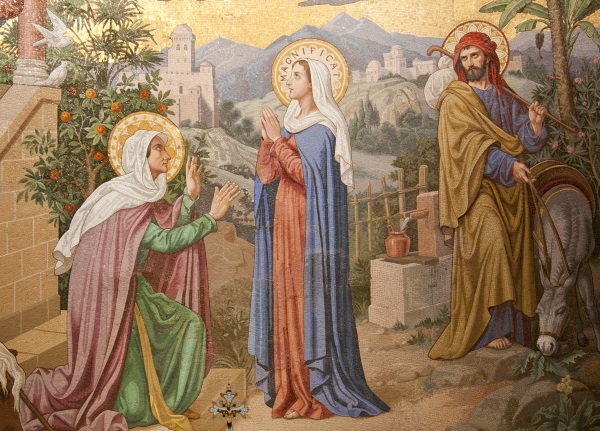
Mary, who traveled through rough terrains from Nazareth in Galilee, arrived safely at the house of Elizabeth and Zachariah in Judea, as she was protected by God, whose power overshadowed (Luke 1:35). And as Mary greeted Elizabeth upon her entry, the infant in Elizabeth’s womb leaped for joy, while Elizabeth was filled with the Holy Spirit (Luke 1:41). It was not only Elizabeth’s son in her womb, John the Baptist, but also Elizabeth herself, overjoyed to have Mary. So, filled with the Holy Spirit and joy, which is the first aspect of the fruit of the Holy Spirit (Galatians 5:22), Elizabeth cries out:

Most blessed are you among women, and blessed is the fruit of your womb. And how does this happen to me, that the mother of my Lord should come to me? For at the moment of the sound of your greeting reached my ears, the infant in my womb leaped for joy. Blessed are you who believed that what was spoken to you by the Lord would be fulfilled (Luke 1:42-45).

It is noteworthy that Elizabeth obviously knew that Mary’s virgin pregnancy was an act of God to make her the Theotokos, as she recognize Mary as “the mother of my Lord”(Luke 1:43). And, she also knew that her own pregnancy at an old age, after years of being barren, was also an act of God, freeing her from all the disgrace of being a childless woman (Luke 1:25; cf. Jeremiah 23:30; Psalm 128:1-4). Above all, when Elizabeth spoke this to Mary, she was filled with the Holy Spirit. Thus, it was the Holy Spirit to have prompted Elizabeth to express her joyful acknowledgement of Mary’s pregnancy with the Son of God. She was, at the same time, so honored and blessed to have been visited by the Son of God in Mary’s womb, in addition to the blessing that she has already received to be pregnant at her old age, being freed from the disgrace of being barren.

Elizabeth also thinks that those who believe Mary’s virgin pregnancy with the Son of God, as announced to Mary by Angel Gabriel (Luke 1:31-33, 35-37), are blessed as it will be fulfilled upon the birth of the Son progressively (Luke 1:45). 

Now in response to Elizabeth’s words of joy and blessings, Mary speaks her Magnificat, her joyful canticle of glorifying El Shaddai, almighty God of mercy and justice. She attributed all the joy that she and Elizabeth share is thanks to God, who is almighty. Thus, there is nothing impossible for Him to do.

My soul proclaims the greatness of the Lord; my spirit rejoices in God my savior.

For he has looked upon his handmaid’s lowliness; behold, from now on will all ages call me blessed.

The Mighty One has done great things for me, and holy is his name.

His mercy is from age to age to those who fear him.

He has shown might with his arm, dispersed the arrogant of mind and heart.

He has thrown down the rulers from their thrones but lifted up the lowly.

The hungry he has filled with good things; the rich he has sent away empty.

He has helped Israel his servant, remembering his mercy, according to his promise to our fathers, to Abraham and to his descendants forever (Luke 1:46-55).


As Elizabeth was so, being filled with the Holy Spirit, therefore, filled with the first aspect of the fruit of the Holy Spirit, joy (Galatians 5:22), Mary now proclaims that her soul magnifies the Lord (Μεγαλύνει ἡ ψυχή μου τὸν Κύριον – Megalynei he psyche mou ton Kyrion) (Luke 1:46).  The Greek verb, μεγαλύνω (megaluno), which means “to magnify” is also translated as “to glorify” and “to exalt”. So, in magnifying the Lord, Mary is also glorifying and exalting God. And this magnification – glorification – exaltation of El Shaddai, almighty God, in Luke 1:46 is comparable to the spirit in Psalm 69:31, אֲהַֽלְלָ֣ה שֵׁם־אֱלֹהִ֣ים בְּשִׁ֑יר וַאֲגַדְּלֶ֥נּוּ בְתֹודָֽה׃ – ahallah sem elohim besir waagaddelennu betowdah: I will  praise God’s name in song and glorify (magnify) it with thanksgiving.   The Greek word, μεγαλύνω (megaluno) in Luke 1:26 corresponds to the Hebrew word, גָּדַל (gadal) in Psalm 69:31, as both of these biblical words mean “to magnify and to glorify”, referring to God.

Not only that Mary magnifies – glorifies almighty God in her soul (Luke 1:46) but also rejoices over Him for giving special grace on her, though she is just a lowly peasant girl in Nazareth, just betrothed to Joseph, making her blessed, therefore, making her known as the Blessed Virgin (Luke 1:47-48).

And, Mary sings this God, whom she magnifies and glorifies in her soul, is holy as it is in his name (Luke 1:49) echoing Psalm 119:9, for He sure has done great things on her, including having chosen her as the Theotokos, by making her the Immaculate Conception – being full of grace, echoing Psalm 126:2–3. Now Mary sees her virgin pregnancy as a great thing done by God, whom she magnifies in her soul with joy. u

Then, Mary sings out the mercy of God onto those who revere Him throughout ages (Luke 1:50),, followed by her singing of  how God’s salvation will unfold with His mercy and justice, perhaps, projecting what the Son in her womb will bring about, in His might (Luke 1:51-54), and all of this is to further fulfill His covenant given to Abraham (Luke 1:55), recalling Genesis 12:1-3; 13:15; 17:7; 18:18; 22:17–18.

See Mary’s profound insights into her pregnancy, though she at first did not understand but just accepted with her fiat. She now begins to understand, as filled with the Holy Spirit, in her magnification of God!

Now, we ask ourselves:

Has Angel Gabriel came and announce in regard to the incarnated Christ and your mission personally?

If so, have you responded with your fiat?

If so, have you been filled with joy, which is the first aspect of the fruit of the Holy Spirit, thus being filled with the Holy Spirit, as well, to glorify almighty God, El Shaddai, in your magnificat canticle?

In other words, by now in this Advent Season, have you been like being Mary upon the Annunciation and the Visitation, the first two joyful mysteries of the Holy Rosary?

Tuesday, December 22, 2020

Advent Reflections : Day 22 - Joseph’s Submission to God’s Plan, Another Indispensable Factor for the Arrival of the Incarnated Christ

Matthew 1:18-25 (in connection to Luke 1:26-38) 

John describes that Christ is the Word-God, who pre-existed before the time, (John 1:1) and made his theophany in the human flesh of Jesus to be live among us (John 1:14), and John the Baptist testifies as the Lamb of God, who takes away the sin of the world(John 1:29) and the Son of God (John 1:34). But, the way Christ was incarnated to dwell among us (Luke 1:26-38; Matthew 1:18-25) is not pleasant at all but rather disturbing and even scandalous. Imagine what it would be like for a young betrothed virgin, finding herself pregnant. Betrothal is a step toward consummation of marriage, about a year-long period before living together. So, nobody would even suspect such a virgin would be pregnant. If that had happened, it would be assumed that it was due to adultery and therefore subject to death (Leviticus 20:10; Exodus 20:14).

Perhaps, God was testing not only Mary but also Joseph if they would be able to carry out His will to bring down His only begotten Son as the incarnated Christ, who comes through the virgin birth to be Emmanuel (Isaiah 7:14) and to be the great light, as well as the prince of peace, who is the mighty Davidic king (Isaiah 9:1-6). Had this betrothed couple been more concerned about themselves, then, they might not accept God’s will.

Mary could have could have been tempted with abortion or would go insane with the fact that she was made pregnant without any relationship with a man, but nobody would believe so. Joseph could have rejected Mary for having felt his trust being violated to find the woman of his betrothal already made pregnant by someone other than him.

According to Luke 1:26-38, Mary passed this test, because of her fiat. And according to Matthew 1:18-25, Joseph passed this test because of his consent.  God wanted both Mary and Joseph to submit themselves to His grand plan to send His only begotten Son as the incarnated Christ, which had been planned ever since before the time, given His intent to have Mary as the Immaculate Conception, as well.

 Even Mary accepted God’s plan with her fiat, what if Joseph rejected Mary?

Imagine, how difficult her life would be without her marriage to Joseph, to live as a single pregnant woman. The eyes of the Jewish society would see her pregnancy as a result of adultery. And there could easily be at least two false testimonies to sentence her to death, according to the Law (Leviticus 20:10). Then, Christ in her womb would be killed together with Mary.

But, Joseph’s quiet consent to God’s plan on Mary and therefore taking her as his legal wife spelled out all these potential problems away, assuring the growing incarnated Christ to come safely to us out of Mary’s womb.

So, let us reflect on how both Mary and Joseph dealt with and overcame their initial difficulties with Mary’s surprise pregnancy, helped by Angel Gabriel.

With these words, Gabriel helped Mary accept God’s plan:

Do not be afraid, Mary, for you have found favor with God. Behold, you will conceive in your womb and bear a son, and you shall name him Jesus. He will be great and will be called Son of the Most High, and the Lord God will give him the throne of David his father, and he will rule over the house of Jacob forever, and of his kingdom there will be no end. The Holy Spirit will come upon you, and the power of the Most High will overshadow you. Therefore the child to be born will be called holy, the Son of God (Luke 1:30-33, 35).

And now, with these words, Gabriel helped Joseph, Mary’s betrothed one, accept God’s plan, which is to accept Mary as his legal wife and her Son, as his step-son.

Joseph, son of David, do not be afraid to take Mary your wife into your home. For it is through the Holy Spirit that this child has been conceived in her. She will bear a son and you are to name him Jesus, because he will save his people from their sins (Matthew 1:20-21).


As explained to Mary, Gabriel also tells Joseph that Mary’s pregnancy prior to the consummation of her marriage to him was not scandalous because it was done by the power of God through the Holy Spirit. And, to Joseph, Gabriel explained that God made Mary pregnant as fulfillment of Isaiah 7:14, reminding Joseph, “Behold, the virgin shall be with child and bear a son, and they shall name him Emmanuel, which means ‘God is with us’” (Matthew 1:23).

So, Joseph accepted his call to serve God by taking Mary, who already bore the Son of God, as his wife. This way, Mary did not have to worry about all societal and legal problems that her “surprise” pregnancy could bring.

Yes, Mary’s fiat to God’s will on her to serve Him as the Theotokos (mother of God, the Son of God) is an absolutely necessary factor for the incarnated Christ to make his theophany at his Nativity, as we reflected yesterday with Luke 1:26-38. But, with Matthew 1:18-25, we also reflect how important Joseph’s consent to accept pregnant Mary as his wife is to ensure God’s plan to bring the incarnated Christ to be carried out, though the Son in her womb was not his.

We are grateful that neither Mary nor Joseph put their personal interests and plans against God’s plan of His Son to be brought to us as the incarnated Christ.

Learning from the obedience of Mary and Joseph, let us put God’s will for us over everything else, including our own plans and agendas, in fine-tuning our preparatory works to receive Christ in our hearts.

Let us remember that Mary's fiat (Luke 1:38) might not have its full effects as the Nativity of the Lord without Joseph's silent consent to God's will on him to accept Mary, with the Son of God in her womb, as his legal wife. 

Monday, December 21, 2020

Advent Reflections Day 21: Can God Have Our Fiat for Sending His Son, Christ, to US? - Final Countdown to the Arrival of Christ

 Though it had been prophesized for at least 1,000 years before…at the time of King David’s reign of Judah……..though it had been planned ever since the time of the fall of Adam and Eve to Satan’s temptation…..though it had been planned ever since before the time…the very annunciation of the incarnated Christ’s coming came as a total surprise first to Mary…then to Joseph. This news comes to Mary and her husband, Joseph, because Mary had been chosen to be the critical instrument for Christ to make his theophany in the human flesh of Jesus. So, at the Annunciation, Angel Gabriel, a messenger of God, told Mary that she had been chosen to serve God as the Theotokos, as she has conceived the Son of God, who is Emmanuel, prophesized in Isaiah 7:14, to be named as “Jesus”, which means “God saves”.

In fact, the Annunciation is the first concrete incidence to unfold what had been prophesized ever since Genesis 3:15, to reverse what Satan had done to the humans through Adam and Eve. The salvation and redemption by the Son, Christ, is consummated with the total destruction of Satan and all of his collaborators (Revelation 20:7-9).

God the Father had chosen Mary to be the Theotokos, intending to make her the Immaculate Conception, before the time, as indicated by Bl. Pope Pius IX in his “Ineffabilis Deus”(1854), and Christ pre-existed with God the Father as the Word (John 1:1), as well as, the Wisdom (Proverbs 8:22-36), to be sent to us in the human flesh as Emmanuel (which means God with us), to dwell among us (John 1:14). And, God had decided to do so in response to the fall of Adam and Eve to Stan’s temptation (Genesis 3:15). And, the coming of this Christ was prophesized as the Davidic king, during the reign of King David (2 Samuel 5:12-16), about 1,000 years before the Annunciation. Then, through Isaiah, God gave more specific prophecy about the incarnated Christ to be born of a virgin and to be Emmanuel, which means “God with us”, indicating the divinity of the son born of the virgin (Isaiah 7:14), during the reign of King Ahaz of the house of David, to whose sin, God revealed this. And, God further more revealed that Christ comes as the great light (Isaiah 9:1-6), echoing Christ’s self-identification as the light (John 8:12). It was more than 700 years before the Annunciation.

So, if the incalculable time span of God’s plan to send His only begotten Son, Christ, who was with God as Logos-Theos (Word-God), in the human flesh (John 1:1, 14), before the time to be compared to a day, 24 hours, say that God’s plan to send His only begotten Son, Christ, in the human flesh, through Mary, the Immaculate Conception, before the time, as the 0:00, the Annunciation comes at the very last minute of the day, 23:59. So, these 9 months of Mary’s pregnancy constitute only the very last minute of a day.

Now, with the solemn feast of the Nativity of the Lord less than 5 days away, we are like being in this last minute before the arrival of the incarnated Christ, which God the Father had planned eons ago, before the time.

So, in this very last minute, God first made Elizabeth, who had been thought as barren, pregnant with John the Baptist, to prepare the way of the coming of Christ (Luke 1:5-25; John 1:19-34; Acts 13:23-25). And, upon the birth of John the Baptist, his father, priest, Zachariah, prophesized the coming of Christ as the daybreak from the heaven above (Luke 1:78), as the birth of John the Baptist was in the process of Christ’s coming.

And, this is how the coming of Christ was first announced to Mary, the virgin betrothed to be the wife of Joseph, living in Nazareth.

Hail, favored one! The Lord is with you, greeted the Angel Gabriel, a messenger of God from heaven (Luke 1:28), out of the blue.

At first, Mary could not comprehend what this was all about – what sort of greeting it was (Luke 1:29).

Sensing her surprise and wondering what this was all about, Gabriel said to Mary:

Do not be afraid, Mary, for you have found favor with God. Behold, you will conceive in your womb and bear a son, and you shall name him Jesus. He will be great and will be called Son of the Most High, and the Lord God will give him the throne of David his father, and he will rule over the house of Jacob forever, and of his kingdom there will be no end (Luke 1:30-33).

Note that Gabriel repeated in indicating that Mary is highly favored one, meaning that she is “gratia plena”, she is, indeed, “Ave Maria, gratia plena”(Hail Mary, full of grace). Mary being favored one (Luke 1:28,30) means that she is the Immaculate Conception so that she has been full of grace imperviously against any corrupting effects of the Original Sin. And, Mary had to be this way, being highly favored one, full of grace, the Immaculate Conception, to let her flesh be used for the incarnation of Christ.

So, Gabriel announced to Mary of her virgin pregnancy with the Son of God, the Son of the Most High, who is to be named “Jesus”, which means “God saves”, and is Davidic king. This is to indicate that what had been prophesized since the time of King David for about 1,000 years (2 Samuel 7:12-16) and since the time of King Ahaz, a corrupt Davidic king, for more than 700 years (Isaiah 7:14, 9:5-6), also further envisioned in later years (Isaiah 52:1-12, 60:1-9).

But, it was just too much for Mary, the virgin, about age 15, to comprehend. So, Mary said:

How can this be, since I have no relations with a man? (Luke 1:34).

In other words, Mary wonders how she can ever become pregnant as she is virgin, not yet consummated her union with Joseph. Yes, it makes no sense for a woman to become pregnant without a physical relationship with a man. In fact, such a thing is impossible for the humans.

So, a messenger of God, Gabriel, replies to Mary’s wondering:

The Holy Spirit will come upon you, and the power of the Most High will overshadow you. Therefore the child to be born will be called holy, the Son of God (Luke 1:35).


Basically, Gabriel is telling Mary that her virgin pregnancy is done by the power of the Most High, by the power of God the Father in heaven – because He had chosen her even before the time as His highly favored one, already making her “full of grace” against any corrupting effect of the Original Sin, so that she is the new Eve, the Immaculate Conception. So, Mary is and will be always overshadowed by God – God is always with her. So, for this reason, the son conceived in her womb is holy Son of God.

In addition to this explanation, Gabriel also announced Mary of Elizabeth’s surprise pregnancy – though she had been thought as barren (Luke 1:36).

And, Gabriel concluded that even a virgin, Mary, becomes pregnant and that even a barren, Elizabeth, Mary’s relative, becomes pregnant, as God wills so, because even what is impossible with the humans is possible with God (Luke 1:37), reminding that God who made not only Mary the virgin but also Elizabeth, the barren pregnant is God of almighty, El Shaddai (i.e. Genesis 17:1; Jeremiah 32:17).

So, Mary responded with her fiat:

Behold, I am the handmaid of the Lord. May it be done to me according to your word (Luke 1:38).

These words of Mary’s fiat to all that announced about her unexpected pregnancy make the critical threshold to make this God’s plan, spanning eons since before the beginning of time, to bring forth His only begotten Son, Christ, to us in the human flesh of Jesus to let him dwell among us for our salvation and redemption – and eventually to destroy Satan, who corrupted the humanity with the temptation. Imagine, had Mary ever rejected what is announced to her because she were not the Immaculate Conception, not full of grace imperviously to any corrupting effects of the Original Sin. Then, God’s grand scheme to bring the incarnated Christ could have been significantly disrupted.

Remember, Mary is not divine at all. She is fully human, just like us. She is the Immaculate Conception, full of grace, to give her flesh to her Son, so that his flesh is unblemished – so that he can save as the salvific Lamb of God through his blood (John 1:29, 36; Exodus 12:3-13; Isaiah 53:7; 1 Peter 1:2, 19; Revelation 5:12; cf Leviticus 1:10). We may not be called to serve God as Mary has, as God only needs one Theotokos. But, each of us, by virtue of Baptism, is called to serve God and to take our part to continue on with God’s grand scheme of salvation and redemption, as well as the destruction of Satan. For this reason, we have been awaken and remained vigilant and diligent in preparing ourselves to receive the incarnated Christ in our hearts, better than the manger, about 2,000 years ago.

Mary has shown us a perfect example of how we respond to God’s call – God’s invitation to take part in making the coming of Christ in every-day reality through us – through our contrite and clean hearts of humility and love.

So, from now until the day of his arrival, in this very last minute, counting since before the time, can we assure of ourselves be like Mary – to be channel of Christ’s arrival?  Can we show our fiat to God?

Can God make it be done unto us, according to His word, as we fine-tune our reception of the incarnated Christ?

Sunday, December 20, 2020

Advent Reflections Day 20: Our Humble Cries of “Maranatha” in tune with David’s “Maranatha” in Psalm 132

 Psalm 132:1-10

Now on the 20th day of December, 5 more days to celebrate Christmas, the arrival of the incarnated Christ, at his birth, given by Mary, in Bethlehem, about 2,000 years ago, what is in our minds?

Anxious to see the incarnated Christ in his theophany?

Are we on the right mind-set and really ready to witness the arrival of the incarnated Christ at any moment?

Or, are we stressed out with all these noises and lights of the world?

Remember, how Zechariah envisioned the coming of Christ prophetically, as the daybreak from the heaven above in his Benedictus (Luke 1:78), upon the birth of his son, John the Baptist, knowing that John was born to prepare the way of the coming of Christ (Luke 1:76-77)? And, Zechariah also indicated that the coming of Christ is out of the mercy of God the Father (Luke 1:78).

So, let us remember that what is behind the coming of Christ the Son is the mercy of God the Father.

It is, in God the Father’s merciful response to our cries out of the depth of the darkness of our sins, reflected in Psalm 130, that Christ has been sent to us.

So, we raise our cries for God’s mercy out of the depth of the darkness of our sins, trusting that God of mercy will wipe away the darkness of our sins, as the rising sun at the daybreak will spell out the darkness of night.

But, we do our part with penance, while God is doing His part with mercy.

So, we now make sure that we are with our humble heart, renewing our hope for Christ, as reflected in Psalm 131.

With his humble heart, David was in eager and vigilant hope to have the dwelling place of God, as he sung in Psalm 132.

After Saul’s fall, David worked and fought hard to establish Jerusalem not only as the place of his reign as king of Israel but also where God dwells for the kingdom. For this reason, David brought the Ark of Covenant to Jerusalem.  For David, being king of Israel means his service to God, knowing that he was anointed as king of Israel to shepherd the people of God. And, as  God’s servant, David was hoping to have the permanent dwelling place of God, replacing the Ark of the Covenant, which was considered as a temporary place of God.

In Psalm 132, David sung his heart for God’s permanent dwelling place and his vow to remain vigilant until he secure the perfect dwelling place of God.

Remember, the running theme of vigilance from the day one of Advent to prepare ourselves for the arrival of the incarnated Christ?

Our vigilant hope for the arrival of Christ is also reflected in Zechariah’s prophecy of the coming of Christ as the daybreak (Luke 1:78).

So, David sings:

I will not enter the house where I live, nor lie on the couch where I sleep; I will give my eyes no sleep, my eyelids no rest, till I find a place for the Lord, a dwelling for the Mighty One of Jacob (Psalm 132:3-5).


Perhaps, David was originally thinking of building the Temple for God. But, as  God indicated to David through prophet Nathan, it is not David to build the house of God but it is God to build the house of David into the permanent Kingdom with his offspring, implying to Christ, who is Davidic King (2 Samuel 7:5-16).

So, how do we apply David’s desire for God’s dwelling place?

It is our hearts, which we have been prepared as the place for Christ to arrive and to dwell upon his arrival. For this reason, we have heeded John the Baptist’s call to prepare the way of Christ, who is coming. And, as David disciplined himself to stay with vigilant hope for the dwelling place of God to be established, we have been so ever since the first day of Advent.

So, we sing now, “Arise, Christ the Lord, come to our hearts, your resting place after a long long journey that you have taken, ever since before the Creation, before the time began”, in line with David’s singing, “Arise, Lord, come to your resting place, you and your mighty ark”(Psalm 132:8).

This is our humble “maranatha” cry with our vigilant hope, in line with King David’s voice in Psalm 132, while the incarnated Christ in Mary, on the donkey, accompanied by Joseph, is coming nearer and nearer, only 5 days away.

Saturday, December 19, 2020

Advent Reflections Day 19: Raising Our Voice of Cries for God’s Mercy, while Christ, God’s Response with His Mercy, Continues to Descends towards Us

 Psalm 130:1-8

Remember, in his prophecy on the coming of Christ, Zechariah sees the arrival of Christ as the daybreak from the heaven above (Luke 1:78). And, in anticipating the coming of Christ, Psalmist sung his hope for Christ in “Song of Ascent”.

Out of the depths I call to you, Lord; Lord, hear my cry! May your ears be attentive to my cry for mercy (Psalm 130:1-2).

Out of the depth of our contrite hearts, we look up to God in heaven, for His mercy, hoping that our cries for His mercy be heard. Our of the darkness brought by our sins, we ask God for the light of salvation.

If you, Lord, keep account of sins, Lord, who can stand? But with you is forgiveness and so you are revered (Psalm 130:3-4).

We trust that our God is God for forgiveness (Psalm 86:5), not of vengeance. We know that our God is God of mercy (Deuteronomy 4:31; Psalm 103:8) and His love endures forever (Psalm 136). These two verses reflect our trust of God as the one who can blot out our sins (Isaiah 43:25) to give us a fresh start. And, our hope for this new start with sinless state is where our hope for Christ’s coming is hinged upon.

So, now with our trust and hope in God’s mercy and forgiveness, we discipline ourselves to remain vigilant as a night-watch for the arrival of Christ, the daybreak from the heaven above, as the below verses reflect:

I wait for the Lord, my soul waits and I hope for his word.

My soul looks for the Lord more than sentinels for daybreak. More than sentinels for daybreak, let Israel hope in the Lord, for with the Lord is mercy, with him is plenteous redemption, and he will redeem Israel from all its sins (Psalm 130:5-8).


There is an image of the new dawn signals the rising sun will wipe out the darkness of night, in juxtaposition to our hope of God’s mercy sending Christ to redeem us from the darkness of our sins, coming to us as the daybreak from heaven. So, we stay awaken and vigilant in our hope to witness the arrival of the new light of redemption.

Redemption of Israel here also means that the redemption of the world.

Christ to redeem makes his first theophany in Bethlehem and completes his salvific Paschal Mystery in Jerusalem through his death and resurrection in Jerusalem. Then, from Jerusalem to the rest of the world, Christ’s salvific and redemptive light radiates all the way to the ends of the earth, while people of the world will see this great light and start walking his way toward the new Jerusalem, the Church.

Christ, who has been on his way, descending from heaven above, now much nearer to us, let us once again raise our cries for God’s mercy along with this Son of Ascents, while we heighten our vigilant hope for the nearness of the arrival of Christ as the new daybreak.

Mary’s Fiat: Indispensable Factor of the Incarnated Christ’s Arrival - 4th Sunday of Advent, B

 We have been awakened to the prospect of Christ’s coming on the First Sunday of Advent. On the Second Sunday of Advent, we were reminded that we had some work to do – the work to prepare the way of Christ to come to our hearts, by John the Baptist. So, we have gotten rid of ups (mountains) and downs (valleys), all these ruggedness in our hearts.  So, we have been working diligently with a vigilant hope. Then, on the Third Sunday of Advent, sensing the nearness of Christ in his coming, our hearts grew with anticipatory joy, making us even more diligent in fine-tuning our preparatory work and heightening our vigilance to witness the moment of theophany at his arrival. So, now, finally, on this last Sunday of Advent, the last Sunday before the Nativity, what are we to reflect on?

Given the imminence of Christ’s arrival, it is the Sunday to reflect how he actually comes about through Mary (Gospel Reading) and through the Davidic royal lineage (First Reading) as the incarnated Logos-Theos (Word-God).

The First Reading (2 Samuel 7:1-5, 8-12, 14, 16) offers some important Christological insights about the Son to be born of Mary, while the Gospel Reading (Luke 1:26-38) describes how this Christ has been conceived in the womb of Mary and how she responded to this. The Second Reading (Romans 16:25-27) describes what Christ, who is wisdom, brings upon his arrival – to strengthen us to live according to the Good News of his, to live a life of faith, through the revelation of a long-kept mystery, namely, the Paschal Mystery of Christ.

What bridges the First Reading and the Gospel Reading is Isaiah 9:5-6, while the Gospel Reading is to fulfill Isaiah 7:14 as to initiate the fulfillment process of Genesis 3:15.

About 1,000 years before the birth of Christ, God first revealed to Nathan, prophet in service of David, that it is God who builds the house of David into the mighty kingdom of peace to last forever, rather than David to build the house of God (2 Samuel 7:5-16). In fact, God is more specific about how He will build the house of David, the Davidic kingdom into the great power over the world, with which all the wicked are conquered, through the offspring of David, namely, Christ coming out of the David’s lineage (2 Samuel 7:12-13). So, it makes sense to see the name of Jesus, the Christ, in Matthew 1:6-16, in the lineage of David.

God’s revelation of His plan to bring Christ out of the David’s lineage and to build his Kingdom in 2 Samuel 7:5-16 is also reflected Isaiah 9:1-6 in Isaiah 7:13-20, echoing Genesis 3:15. The establishment of the house of David as his Kingdom by his offspring, Christ, will bring permanent peace, as all the wicked enemies are conquered as to defeat the source of all the evils, Satan. So, nearly 1,000 years before the arrival of Christ in Bethlehem, God the Father, who has sent Christ the Son, already gave this prophetic vision to Nathan to tell David. And, more than 700 years before the coming of Christ, Isaiah prophesized the coming of Christ and what he will bring in line of what is told to David through Nathan.

Now, the Gospel Reading (Luke 1:26-38) describes how what was revealed to David through Nathan, by God the Father on Christ the Son, nearly 1,000 years before finally made known to Mary through Angel Gabriel’s Annunciation and how she responded with her fiat; ”Behold, I am the handmaid of the Lord. May it be done to me according to your word”(Luke 1:38).


The Gospel text (Luke 1:26-38) is also read for the Solemn feast of the Immaculate Conception (December 8), for the feast of Nuestra Senora de Guadalupe (December 12), and Solemn feast of the Annunciation (March 25), in addition for the 4th Sunday of Advent on Cycle B. This is because this text is more than the annunciation of the birth of the incarnated Christ but also about Mary, the Mother of Christ, the Theotokos.

Because God had His special eyes on her, even before her conception, even before the time, as Blessed Pope Pius IX indicates in Ineffable Deus to establish the dogma of the Immaculate Conception of Mary, Angel Gabriel told Mary that she has special favor (grace) in her, and God has been with her always (Luke 1:28). This is what makes Mary “gratia plena”, impervious to evil effects of the Original Sin. And, this qualified Mary to conceive the incarnated Christ in her womb so that Christ, the Son of God, comes to us in the unblemished human flesh of Jesus to redeem us, as prophesized.

It is also important to note how Angel Gabriel tells what her Son will bring about (Luke 1:32-33) in connection to prophesies in the Old Testament. Though it was too much for Mary to comprehend, Angel Gabriel told her that the Son already conceived in her womb, though she is virgin, by the power of the Holy Spirit, is destined to be the great Davidic King, as prophesized in 2 Samuel 7:12-16, Isaiah 7:13-20, Isaiah 9:6-9, and Isaiah 11:1-16.

All this great annunciation of the Son of God being conceived in her womb by the power of the Holy Spirit certainly overwhelmed her, an unexpected virgin. So, her verbal response to all this is,” How can this be, since I have no relations with a man?”(Luke 1:34).

And, these are the words of Angel Gabriel to respond to Mary’s wonder:

The Holy Spirit will come upon you, and the power of the Most High will overshadow you. Therefore the child to be born will be called holy, the Son of God. And behold, Elizabeth, your relative, has also conceived a son in her old age, and this is the sixth month for her who was called barren; for nothing will be impossible for God (Luke 1:35-37).

Mary was reminded that it is possible with God even it is impossible to the humans to help her accept the new reality of her conceiving the Son of God, as the redeemer in the form of the great  Davidic king, fulfilling the aforementioned Old Testament prophecies. Also, she was told of the surprised pregnancy of Elizabeth, who had been barren for years. For God, as He wills so, the virgin conceives, and a barren conceives, too. And, the son that Elizabeth conceives is to prepare the way of Christ (Luke 1:13-17; Matthew 3:1-12//Mark 1:1-9//Luke 3:1-18; John 1:19-28).

All Mary needed was that it is what God wills not only upon her but also upon Israel and beyond. At that point, perhaps, Mary has felt a sense of great responsibility beyond herself, sensing that she has been made pregnant with the Son of God for the sake of salvation of the humankind, who have been lost since the Original Sin. But, being reminded and knowing that God is with her (Luke 1:28), Mary responds with her words of fiat, “May it be done to me” as she accepts God’s will to serve Him as His “handmaid”(Luke 1:38).


Thus, the incarnation of Christ, the Son of God, actually took place before making his theophany with the birth of Christ. Mary needed to cooperate the Word, as God has willed on her.

Imagine, if Mary were not “gratia plena” by the Immaculate Conception, Satan could have affected her mind to reject the incarnated Christ in her womb, going against God’s will on her to be Christ’s mother. If that had been the case, Mary could have obtained self-induced abortion because it was “unplanned pregnancy” and against her will.

Just as David accepted God’s plan for him, which is not that he build the house of God, Temple, but rather to let God build the house of David into the great permanent kingdom through his offspring, Christ, Mary, a descendant of the Levites, accepted God’s plan for her to serve as Christ’s mother. Both David and Mary had to give up their own plans to accommodate God’s plan for them.

What about us? Are we always readily able to accept and accommodate and adapt God’s plan for us, even though it means to give up our own plans for ourselves?

If we reject God’s plan but to stick with our own plans for ourselves, we may “abort” God’s salvific plan that is meant through us.

Are we willing to let God the Father bring Christ through us and let Christ build the Kingdom with us? Do we have our fiats to this, before we will celebrate the arrival of the incarnated Christ? If not, all that great Paschal Mystery will not be revealed to us.

Angelus Domini nuntiavit Mariae; Et concepit de Spiritu Sancto.

Ecce ancilla Domini. Fiat mihi secundum verbum tuum.

Et Verbum caro factum est. Et habitavit in nobis.

Sancta Maria, Mater Dei, ora pro nobis peccatoribus, nunc, et in hora mortis nostrae. Amen.

The angel of the Lord has declared unto Mary, and she conceived of the Holy Spirit.

Behold, the handmaid of the Lord, be it done unto me according to your word.

And the word was made flesh and dwelt among us.

Holy Mary, Mother of God, pray for us sinners, now, and in the hour of our death. Amen.