Following the Trinity Sunday, which comes after the
Pentecost Sunday, we celebrate the feast of Corpus Christi. In fact, we
celebrate not only Corpus Christi
(the Body of Christ) but also Sanguinis
Christi (the Blood of Christ – Corporis
et Sanguinis Christi.
Corpus Christi Sunday really focuses on the
Sacrament of the Eucharist, as Eucharistic adoration marks an important part of
this celebration.
For Cycle B year, the Liturgy of the Word for Corpus
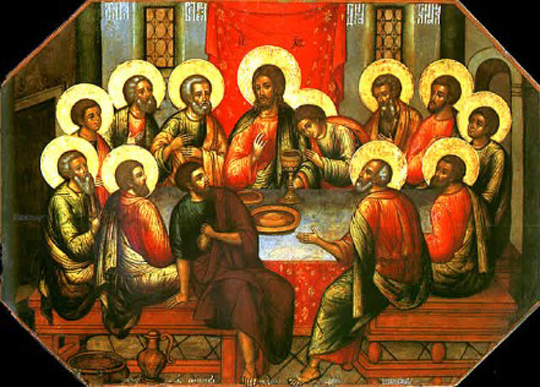
Christi Sunday takes us back to the Last Supper, as the Gospel reading (Mark 14:12-16,
22-26) describes Jesus instituting the Sacrament of the Eucharist.
Though the Sacrament of the Eucharist was instituted by Jesus
during the Last Supper, which is remembered on Holy Thursday, the Gospel
reading (John 13:1-15 for Cycles A,B,C) for Holy Thursday is about Jesus
washing the disciple’s feet. There is no
mentioning about the bread and the wine Jesus shared with the disciples in this
Gospel narrative from John.
John’s Gospel does not describe how Jesus and the
disciples ate the supper, while the Synoptic Gospels (Matthew, Mark, Luke) do not describe feet
washing and Jesus’ discourse. In fact, John’s Gospel does not even connect the
Last Supper to Passover, while the Synoptic Gospels do, because the death of
Jesus on Friday took place before the Passover sundown. In contrast, the Synaptic Gospel narratives
describe the Last Supper as Passover Seder dinner, and Jesus died after
Passover, as the Feast of the Unleavened Bread already started.
This difference resulted from the different focuses
of John’s Gospel and the Synoptic Gospels in regard to the Last Supper and the
death of Jesus. John’s Gospel treats the
death of Jesus as the Passover sacrifice lamb and emphasized on Jesus washing
the disciples feet and giving the lengthy discourse to the disciples. The Last Supper discourse of Jesus includes Mandatum Novum (the New Commandment) to
love one another (i.e. John 13:34). On the other hand, the Synoptic Gospels solely focus on how
Jesus broke the bread, described it as his body, and commanded to eat in his
memory – then, how Jesus pass the chalice of wine, identified the wine as his
blood of the new covenant and asked the disciples to drink it in his
memory. Both Matthew’s Gospel and Mark’s
Gospel describe that Jesus asked the disciples to eat the bread as his body and
drink the wine from the chalice as his blood in his memory until the
eschatological time of his reunion with them in the new Kingdom (Matthew
26:29,Mark 14:25).
My thought is that Corpus Christi Sunday Gospel
reading for Cycle B (Mark 14:12-16, 22-26) compliments the Gospel reading for
Holy Thursday (Maundy Thursday) (John 13:1-15).
Because the Gospel reading for
Corpus Christi Sunday is taken from Jesus’ bread discourse in John 6 (John
6:51-58) for Cycle A and from Luke’s narrative of Jesus feeding hungry five
thousand (Luke 9:11-17) for Cycle C, these Gospel narratives further compliment
the Gospel reading for Holy Thursday and Cycle B’s Corpus Christi Gospel
reading on the institution of the Eucharist.
If you read the Gospel reading for Corpus Christi
Sunday for Cycle B (Mark 14:12-16, 22-26), together with Corpus Christi Sunday
Gospel readings for Cycle A (John 6:51-58) and for Cycle C (Luke 9:10-17), as
well as the Gospel reading for Holy Thursday (John 13:1-15), you can have a more comprehensive view on Corpus
Christi – only the Gospel readings for
Cycle B (Mark 14:12-16, 22-26) and for
Cycle A (John 6:51-58) mention Sanguinis
Christi . Only Cycle B Gospel reading for Corpus Christi Sunday (Mark
14:12-16, 22-26) reflects the Last Supper.
In fact, the Corpus Christi Sunday Gospel reading
for Cycle A (John 6:51-58) alludes to Jesus’ institution of the Sacrament of
the Eucharist, as read in the Gospel reading for Corpus Christi Sunday in Cycle
B (Mark 14:12-16, 22-26).
It is also helpful and interesting to note that
Jesus’ bread discourse (John 6:25-59), which includes the Cycle A Corpus
Christi Sunday Gospel reading (John 6:51-58), took place shortly after feeding
the hungry five thousand on the other side of the Sea of Galilee (John 6:1-15).
Not to mention, Luke’s description of the same event (Luke 9:10-17) is used for
the Gospel reading for Cycle C Corpus Christi Sunday. So, it is important to connect Jesus’
miraculous feeding of hungry five thousand men (Luke 10:10-17; John 6:1-15; Matthew
14:31-21 (cf. Matthew 15:32-38); Mark 6:32-44) to the Last Supper (Mark
14:12-26; Matthew 26:17-30; Luke 22:7-23; John 13:1-17:26) and Jesus’ bread of
life discourse (John 6:25-59).

First, Jesus miraculously fed the hungry five
thousand men out of five loaves of bread and two fish out of his
compassion. The bread and fish were
offered to Jesus to do this miraculous act of compassion. This echoes the offering of bread and wine for
consecration at the altar during the Liturgy of the Eucharist at Mass. Furthermore, the fact that Jesus looked up to
heaven, gave thanks and broke the bread to distribute it to the five thousand
men parallels how Jesus took the bread, gave thanks, and broke it to distribute
to the disciples at the Last Supper, is reflected on the way the presiding priest takes the offered
bread at the altar, raises it as he looks up, and gives thanks in proclaiming
as Jesus did, “Take this, all of you, and
eat of it, for this is my body, which is given up for you”, during the
Eucharistic prayer at Mass. In the
Liturgy of the Eucharist, following the epiclesis, the offered bread on the
altar has become transubstantiated through epiclesis by the time the priest
fishes citing Jesus’ words of proclaiming it as his body. This is ex
opere operato for the bread and the wine to become the Body and the Blood
of Christ, as the Sacrament of the Eucharist.
When Jesus miraculously fed the hungry five
thousand, there was no indication to connect the bread to his body. The crowd
had no idea what their miraculous experience with Jesus would entail to. But,
they thought Jesus was a prophet to have demonstrated such a miraculous sign as
feeding the five thousand out of only five loaves of bread and two fish.
Furthermore, they were thinking to force Jesus to become their king, and Jesus
had to withdraw himself from them because of this situation with the crowd he
fed (John 6:15).
Later that evening, the disciple got on a boat,
while Jesus was still on the mountain, where he withdraw from the crowd, and
began to cross the Sea of Galilee to Capernaum. It was when the weather became
stormy and terrified the disciples. Then, they saw Jesus walking on the water
toward their boat. Next day, the crowds fed by Jesus chased him all the way to
Capernaum and found him.
It was to this crowd, who kept chasing Jesus upon
being miraculously fed, that Jesus addressed the bread of life discourse and
began it with these words:
I
tell you the truth, you are looking for me, not because you saw miraculous
signs but because you ate the loaves and had your fill. Do not work for food
that spoils, but for food that endures to eternal life, which the Son of Man will give you. On him God
the Father has placed his seal of approval (John 6:26-27).
Through his bread of life discourse (John 6:25-59),
Jesus wanted the crowds to focus on the spiritual aspects of the bread given by
him, rather than its material quality. As this opening statement of Jesus’
bread of life discourse shows, Jesus had to teach, what is understood as the
spiritual discipline of detachment in Buddhism, to this crowds, who seemed
obsessed with Jesus, who feeds miraculously.
Jesus knew that the crowds would go through vicious
cycle of hunger, if their focus remains on physical or material aspects of the
bread. Clearly, Jesus’ messianic and salvific mission on earth is not to keep
feeding the hungry in this vicious cycle of hunger. In fact, his mission is to
liberate us all from this vicious cycle of hunger, as well as the cycle of
thirst, which is due to our attachment to material or physical aspect of the
source of our sustenance. The bread and
the wine, consecrated and transubstantiated as Corporis et Sanguinis Christi and as the Sacrament of the
Eucharist, are Jesus’ way to help us fee ourselves from our tendency to sustain
ourselves only materialistically and earthly. This way, we can break free from
the vicious cycle of hunger by attaining non-attachment to material and earthly
matters.
So, here, we can see a common thread between Jesus’
teaching of focusing on spiritual factors and Shakamuni’s teaching of alobha (無貧) in terms of detachment from the
material and physical matter.
As Jesus and the crowd moved from one side of the
Sea of Galilee to the other side, to Capernaum, after being miraculously fed,
there is a shift on focus: from material and earthy matters to a spiritual
aspect, in order to guide us to the concept of the Eucharist and its
institution by Jesus at the Last Supper. In this regard, the crossing the Sea
of Galilee can be symbolically understood as a threshold to move from the realm
of solely materialistic and earthly realm toward the more spiritual realm,
where alobha-like non-attachment is
practiced.
What Jesus meant by “miraculous signs” (John 6:25) in the above opening statement of his
living bread discourse is the divine spiritual power that enabled scant amount
of bread of fish to satisfy five thousand hungry men.
The miraculous sign of feeding the five thousands in
Galilee is the divine spiritual power prototypical for the transubstantiation
that turns the bread and the wine into Corporis
et Sanguinis Christi. Unless we understand this, we sure do not understand
why Jesus said, “This is My body which is
given for you; do this in remembrance of me”(Luke 22:19, cf. Mark 14:22;
Matthew 26:26), holding the broken bread, why he said, “This is my blood of the
covenant, which is poured out for many” ( Mark 14:24, cf. Matthew
26:28; Luke 22:20), holding the challis filled with wine, during the Last
Supper .
Unless we truly understand what Jesus meant by the “miraculous signs”(John 6:26), we really
cannot understand what Jesus meant by saying,
“I am the bread that came down from heaven”(John 6:41), “I am the living bread that came down from
heaven; whoever eats this bread will live forever; and the bread that I will
give is my flesh for the life of the world”(John 6:51), “Amen,
amen, I say to you, unless you eat the flesh of the Son of Man and drink his
blood, you do not have life within you. Whoever eats my flesh and drinks my blood has eternal life, and I
will raise him on the last day. For my flesh is true food, and
my blood is true drink. Whoever eats
my flesh and drinks my blood remains in me and I in him”(John
6:53-56), in his living bread discourse in Capernaum. Unless we really understand this, we remain
unable to see the consecrated bread and wine at Mass being transubstantiated
into true Corporis et Sanguinis Christi. Also, unless our heart is in the state of
grace, because of our inability to the alobha-like
non-attachment to the material and earthly matters, we remain too ignorant to
see the consecrated bread and wine as true Corporis
et Sanguinis Christi in our eyes of the heart.
This aspect of Jesus’ bread of life discourse is
similar to what Jesus said to the Samaritan woman by the Jacob’s well (John
4:4-26) and Jesus’ teaching on heavenly treasure vs. earthly treasure from his
sermon on the mount (Matthew 6:19-24). Interestingly, what follows Jesus’ teaching on
non-attachment to earthly treasure (Matthew 9:19-24) leads to his teaching on
overcoming anxiety (Matthew 6:25-34). In fact, this echoes Buddhism’s teaching
on anxiety and attachment to material matter, as Buddhism teaches that anxiety
is rooted in our attachment. What Jesus
wanted the hungry crowds to understand that the very purpose of his feeding
miracle on the other side of the Sea of Galilee was not simply to feed the
hungry but to teach them to overcome
their anxiety from hunger by practicing non-attachment or alobha.
In both Christianity and Buddhism, we are encouraged
to detach ourselves from worldly and earthly objects. It is not only because
these objects come and go but really because such earthly impermanent objects
often mislead us into greed and addictive attachment. One form of this
psychospiritual problem is idolatry. As repeatedly reminded throughout the Old
Testament, idolatry has deadly consequences, for it is a reflection of our
impure heart.
In Theravada Buddhism, to counter impure heart,
which leads to addictive attachment and idolatry, the spiritual principle of alobha is addressed in Visuddhimagga
(清浄道論),
which means the path of purification. Thus, non-attachment, alobha, in Buddhist sense, means to
attain pure heart, free from kleshas (煩悩),
defilements. The spiritual teaching of alobha in Visuddhimagga is certainly echoes in Jesus’ spiritual teaching
that underlines Corporis et Sanguinis Christi,
reflected in Jesus’ Sermon on the Mount, the Living Bread Discourse, and the
Last Supper Discourse.
Let us understand that we must have the alobha-like non-attachment in order for
us to receive the consecrated bread and wine as Corporis et Sanguinis Christi in the form of the Sacrament of the
Eucharist. This is why we must be in the
state of sanctifying grace to receive the Sacrament of the Eucharist (CCC
*1415).
In Buddhism these are understood in terms of impermanence (無常). In
Christianity, out of these impermanent worldly reality, God the Elohim, whom Jesus has called “Abba” (Mark 14:36), delivers us into the
new transcendent reality, like what Jean Piaget’s psychological development
concept calls “object permanence” , with Him by the Ascension of Christ (Luke
24:50-53; Mark 16:19-20), upon making Logos
, who is God, flesh to dwell among us (John 1:1-14). For the Ascension to take
place, the Death and the Resurrection of
Jesus had to take place.
The
disciples had thought that the physical presence of Jesus was gone with his
death and burial, because they did not understand the Resurrection (John 20:9),
though Jesus had already taught about it (i.e. John 2:18-22, 10:17-18; Matthew
16:21, 27:62-63). So, they were quite anxious in encountering the Resurrection.
So, the risen Jesus helped the disciples
understand all of his teaching in retrospect, and they came to terms with the
meaning of Jesus’ death and resurrection.
Unbeknownst to them, however, Jesus’ repeated appearances to help the
disciples better understand his teaching after his resurrection was to prepare
them psychologically and spiritually for his departure, Ascension, and for them
to receive the Holy Spirit, so that they can be commissioned to go and proclaim
the Good News in building the Kingdom of God on earth.
It
was his Ascension and Pentecost that remind us that even the physical presence
of Jesus, the Son, in this world is impermanent. However, what is important in
Christianity is that the presence of Christ, the Son, is permanent, as the
Triune God is the permanent being. That
is why that Christ always remains with us through the Holy Spirit (cf. Matthew
28:20, John 14:26). Thus, the Triune God – One God in Trinity: the Father, the
Son, and the Holy Spirit, is the permanent being, while everything else in the
universe is impermanent. Because the reciprocity of God and the Word (Logos) (John 1:1), the Word of God
through Jesus, especially in his kerygma
, is permanent (Matthew 24:34-35). This permanence of God is very important to
appreciate “object permanence” in our mature spiritual object relation with the
Triune God so that we can truly appreciate transubstantiation from the bread of
life into the Corpus Christi and from
the chalice of wine into the chalice of Christ’s saving blood – the Sanguis Christi.
As
reflected in the bread of life discourse (John
6:25-59), Jesus wanted us to really understand the spiritual aspect of
his body and blood, so that we can overcome our tendency for attachment to
their material aspects. That was a
problem that these five thousand people, who were miraculously fed, had, as
they kept chasing Jesus and as they became hungry again. They could not
overcome hunger because they did not see the bread Jesus gave was his body yet
and did not yet approach the bread with the heart of alobha.
This
spiritual teaching in the bread of life discourse (John 6:25-59) on
non-attachment or alobha is also
found in the last supper discourse (John 14:1-16:33), as the latter discourse
of Jesus is essentially to prepare the disciples for non-attachment or alobha to the physical aspect of himself
– to prepare them for his Ascension and for them to fully appreciate the coming
of Parakletos on Pentecost. For this,
Jesus said:
“Unless I go away, Parakletos will not come
to you; but if I go, I will send him (Parakletos) to you…..I am going to the
Father where you can see me no
longer…….I have much more to say to you, more than you can now bear. But
when he, the Spirit of truth (Parakletos) comes, he will guide you into all
truth. He will not speak on his own; he will speak only what he hears, and he
will tell you what is yet to come. He will bring glory to me by taking from
what is mine and making it known to you. All that belongs to the Father is
mine. That is why I said the Spirit will take what is mine and make it known to
you”(John 16:7, 10, 12-15 ).
“In a little while you will see me no more,
and then after a little while you will see me”(John 16:16).
“Are you asking one another what I meant when
I said, ‘In a little while you will see me no more and then after a little
while you will see me’? I will tell you the truth, you will weep and mourn
while the world rejoiced. You will grieve but your grief will turn to joy. A
woman giving birth to a child has pain because her time has come; but when her
baby is born she forgets the anguish because of her joy that a child is born
into the world. So with you: Now is your time of grief, but I will see you
again and you will rejoice, and no one will take away your joy. In that day you
will no longer ask me anything. I tell you the truth, my Father will give you
whatever you ask in my name. Until now you have not asked for anything in my
name. Ask and you will receive, and your joy will be complete”(John
16:19-24).
“Though I have been speaking figuratively, a
time is coming when I no longer use this kind of language but will tell you
plainly about my Father. In that day you will ask in my name. I am not saying
that I will ask the Father on your behalf. No, the Father himself loves you
because you have loved me and have believed that I came from God. I came from
the Father and entered the world; now I am leaving he world and going back to
the Father” (John 16:25-29).
Now, juxtapose the above words of Jesus from his
Last Supper Discourse in John’s Gospel to the below narrative of Luke on Jesus instituting the Sacrament of the Eucharist at
the Last Supper:
“I
have eagerly desired to eat this Passover with you before I suffer. For I tell you, I will not eat it again until
it finds fulfillment in the kingdom of God. Take this and divide it among you. For
I tell you I will not drink again of the fruit of the vine until the kingdom of
God comes.” And he took bread, gave thanks and broke it, and gave it to them,
saying, “This is my body given for you; do this in remembrance of me.” 2In the
same way, after the supper he took the cup, saying, “This cup is the new
covenant in my blood, which is poured out for you”
(Luke 22:14-20).

You notice that the
Institution of the Sacrament of the Eucharist, transubstantiating the bread and
the wine into Corporis et Sanguinis
Christi by the power of the Holy Spirit, as reflected in this Last Supper
scene (Luke 22:14-20) and the aforementioned excerpt from Jesus’ Last Supper
Discourse (John 16:7-20), as well as Jesus’ Bread of Life Discourse (John
6:25-59), is relevant to the departure of Jesus from this world, the Ascension.
Because of the Ascension is the necessary condition for the Pentecostal Holy
Spirit to be poured upon us and to the bread and the wine offered to the alter
of God at Mass, we truly need to be in alobha
, which enables us to appreciate our transcendental permanent object
relationship with the Triune God, as in what Jean Piaget argues as “object
permanence”. Otherwise, we would have
difficulty with the Sacrament of the Eucharist, as some of those who heard
Jesus’ Bread of Life Discourse deserted Jesus (John 6:60-66), because of their
inability to appreciate the bread of life as the body of Christ and the wine as
the saving blood of Christ.

After
all, Chinese and Japanese Buddhists describe alobha as “無貧“, which suggests “no poverty”. It indicates that the
Chinese and the Japanese Buddhists view the concept of alobha, non-attachment, as a way to overcome poverty. Of course,
poverty here is not about material poverty, but spiritual poverty. This echoes
Jesus’ teaching: Blessed are the poor in spirit, for theirs is the kingdom of
heaven (Matthew 5:3), Jesus’ teaching on humility as the first and foremost
factor for the beatitudes (blessedness, rather than “happiness”). In following this statement in his Sermon on
the Mount, it is clear that Jesus, like Shakamuni, teaches us that alobha is indispensable to live a
blessed life, transcending anxieties and fear.
This
is what we must reflect and ponder every time we bring ourselves to the alter
to receive Corporis et Sanguinis Christi.
Amen.
*CCC - Catechism of the Catholic Church